Monday, May 19, 2008

Love Wenchuan


"If there is the littlest hope, we will use all of our effort"

Great words, and a great man.

5.12, and you were there. Looking pensive.

My words fail me.


What is a leader? Who is a hero?

I was there for Katrina. There, the heroes failed us.

Is this a hero?


Words fail again, only tears.

The hardest of times, and the strongest of men.

There are no words...


Love Wenchuan, love Chengdu.

Thank you Wen Jiabao!

Donations to Red Cross to rebuild the beauty of Wenchuan!

Wednesday, April 09, 2008

三面向公司的“游击战”

谢谢王教授的介绍。今天我想讲的是“三面向公司的‘游击战’”

对社科院知识产权中心的李明德来讲,中国传统文化对版权和知识产权可以用两个概念来描写:一是“窃书不算偷”,或者“偷书不算偷”。这里的意识是普及知识的内在善良、知识内容的无形形式。书只是纸及墨水,根本没有什么价值;软件只是磁带及0和1,根本不值钱。二是“传媳不传女”。这里的意思是女儿是要嫁出去,如果她知道家里的商业或知识秘密,那么其他的家庭将抢本家的饭碗。保护知识产权最理想的办法是非公开的、小规模的发展[1]。

没有物质形式的东西没有价钱和不公开小规模的发展这两个概念在网络社会有什么不搭界?从改革开放以来,中国保护不同类似的产权有没有受到这两个概念的影响?

改革开放一直以来经常见到“模糊”产权。从乡镇企业的所有制度和单位“小公家”的房子到私营公司戴红帽子再到盗版软件,免费mp3下载,和好莱坞拷贝电影,中国当代的产权没有明晰的解释。那么,在这种情况下,三面向的行为是否不恰当的?三面向的“游击战”阻挡了中国版权、知识、社会共识等发展吗?

我个人意见是否。原因在于中国信息产业、网络软件、技术开发等高科技的发展到目前为止已经发展到了一定的程度。为了保护这些公司和机构的将来盈利和持续发展,中国需要更多的像三面向这样的公司来打击模糊产权。

网络是共享为主的神话:一方面对于三面向公司的批判是它买断了一个共享资料,侵犯网络基本上的精神。不过,不管是西方国家也好,中国也罢,网络不是免费共享来发展的。中国的QQ、百度、优酷、土豆网都是直接与广告公司签订合同并收费才能够持续发展。这些知识产品表面上可以免费装载,但实际上每次使用必须参加市场活动。

两种反对可以提出来:一、三面向公司是以实行版权为主收益,并没有出版和普及知识的目的。那么,三面向的“买断”是它公司的营业模式,利用它与学者之间的合法合同来投资并出版一些文章来获得盈利。是否三面向将来会开发一个“许可证”之类的产品,我们无法知道,但三面向的法律战略明晰了出版和发表文章的产业。因为出版后的文章版权是跟着作家而不是跟着出版社,那么作家怎么处理自己的版权完全是他个人的事。

二、因为三面向主要买断了一些与“三农”有关的文章,那么文章的内容大大超过了任何个人或公司的业主权。我认为这样的想法还是找错了对象。如果一篇文章是对中国三农问题那么重要,而不是知识,不是讲话,不是某个教授的研究结果,那么作家卖出这篇文章等于是自己轻视了三农问题。我相信将来这样的事情不再会继续发生。

最后,我在这里提两个网络社会和知识产权的例子:第一来自我母亲。我母亲是一名专职顾问专门提供各种大学信息。自从与我父亲离婚起,为了谋生她成立了一家个人企业,帮助高中学生进入自己梦想的大学。2004年她请了一个设计师为她的企业设计了一个网站,专门介绍自己的服务。2006年她收到了一个(格蒂代表摄影师公司的)通知:她的网站所使用的图片是有版权的,而拥有图片的版权公司准备起诉她,要罚款2000至4000美元。后来,我母亲付了罚款然后从那家公司的营业部门用3730美元买到了该图片2年的使用“许可证”。

第二的例子来自中关村。在清华大学校内有一家公司自己研发一个产品叫“电子鼻子”。发明后拿到了国家专利权并开始生产和销售。一段时间后,另外一些公司,主要在深圳,打开“电子鼻子”的外壳和仿冒了里面的电路板和功能。结果,因为深圳的那些公司没有研发费用,它们可以以很便宜的价钱销售同样的产品。清华那家公司的老板不愿意起诉那些深圳公司因为“第一它们在外地,一旦起诉,将花大量的金钱,而这家公司很快瞬间蒸发。然后另外一家新的公司会成立,开始做一样的是事情”这位老板说。2004年,这位老板终于起诉一家公司:百度。他说起诉百度的重要原因是百度收了假冒公司的广告费用(搜索“电子鼻子”会找到假冒公司的广告)而造成他公司的损失,加上百度公司很大,不会跑掉。

总结一下:中国现在的网络社会越来越发达,也许从某种程度来讲,它已经超过了下线社会的发展。那么,模糊产权对发达网络社会和发展中的民间社会永远带来好处吗?从小规模的角度来看,模糊产权会降低创业、普及知识、和开发产品的成本。但同时模糊产权也影响公司和机构的盈利收入,减少创业、普及、开发等的机会。三面向确实在这方面给我们一个非常及时的提醒。

谢谢大家!


[1] 李明德,2003,“当代中国的智慧财产权制度与社会发展”,台湾清华大学当代中国研究中心的演讲,在 www.iolaw.org.cn/showarticle.asp?id=878,2008年3月4日访问。

The Sanmianxiang Company and IPR

(A version of this was presented at the "'Sanmianxiang Phenomena' Roundtable Forum" held on March 9, 2008 at Shanghai University. It was subsequently published in Chinese by China Business Network here.)

Background: Sanmianxiang (三面向) is the name of a company in Beijing. It was established on October 27, 2004 with registered capital of 2 million RMB and 10 employees. Sanmianxiang is headed by the venerable Zhan Qizhi, a former assistant professor at Henan Finance and Economics University. Sanmianxiang has signed copyright transfer contracts with 150 authors that include over 1000 articles. With copyright contracts in hand, Sanmianxiang has sued hundreds of government, university, and other websites over unlawful transmission and downloading of copyrighted articles. While initially promising authors that Sanmianxiang would publish large collections, instead Sanmianxiang focuses on prosecuting intellectual property scofflaws.

"The 'Guerilla Warfare Tactics' of Sanmianxiang Company"
Tyler Rooker

According to Li Mingde of the China Academy of Social Sciences Intellectual Property Center, traditional Chinese culture has two ideas that deal with copyright and IPR: one is “to steal a book is not to steal” or “to steal a book is an elegant offence.” The meaning of this is that the propagation of knowledge is inherently good, and knowledge is immaterial. Books are only paper and ink, and have not value; software is only magnetic tape and ones and zeros, essentially worthless. Two is “pass to the son not the daughter.” Daughters are married out, so if they know the families commercial or intellectual secrets, those secrets will pass out to other families who will steal the bread and butter. The ideal method for protecting intellectual property is to have closed, small-scale development. (See here).

How do the twin ideas that immaterial things have no value and closed, small-scale development is ideal become conflicted in Internet society? Since the reform and opening of China, has the protection of different kinds of property been influenced by these two ideas?

“Fuzzy” property rights are a common occurrence during the reform and opening era. From the ownership system of township and village enterprises to the “small public family” apartments in danwei, to privately-run enterprises “wearing a red hat” and even to pirated software, free mp3 downloads, and copied Hollywood movies, there is no clear interpretation of property rights in contemporary China. Then, in this situation, is the behavior of Sanmianxiang appropriate? Has Sanmianxiang’s “guerilla war” blocked the development of copyright, knowledge, and social awareness in China?

In my opinion, the answer is no. The reason is that China’s information industry, Internet software, and technology development—the high-tech industry—has already developed to an advanced degree in China. In order to protect the future earnings and continued development of companies and institutions, China needs more companies like Sanmianxiang to strike against fuzzy property rights.

It is a myth that the Internet is basically free: one of the criticisms of Sanmianxiang is that it bought out publicly-shared materials, infringing on the basic spirit of the Internet. But, whether it is the West or China, the Internet is not developed as a free, publicly-shared entity. China’s QQ, Baidu, Youku, Tudou all signed agreements with advertising companies and receive fees in order to sustain development. These intellectual products appear to be free to install and use, but in reality every use is participation in marketing activity.

Two detractions could be raised at this point: one, Sanmianxiang Company enforces property rights as its main business, and never had the goal of publishing or disseminating knowledge. In that case, Sanmianxiang’s “buy out” of copyrights is its business strategy, using its legal contract with scholars to invest and publish some articles and make money. Whether or not Sanmianxiang will create a “certificate”-type of product, that could be leased or paid for dissemination of article, we have no way of knowing. But Sanmianxiang has clarified the legal copyright issues in the publishing and issuing of articles. Because, in China, after publication, the rights to the article stay with the author rather than the press, the onus is on the author in how he/she uses these rights.

The second opposition is that Sanmianxiang bought out articles related to the “three peasant” problems, so the content of the articles far outweighs any individual or company’s ownership rights. I think this type of thinking is directed at the wrong subject. If one article is so important to China’s three peasant problems, and not the knowledge, lectures, or research results of professors, then selling the article is tantamount to belittling the three peasant problem. I believe in the future that this type of issue will not reoccur.

Lastly, I would like to present two examples on Internet society and IPR: the first is from my mother. My mother is a college-preparatory tutor, a college coach. After divorcing from my father, she founded her own company to help high school students get into the college of their dreams. In 2006, she received a notice (from Getty Photographer-Representing Company): the images on her website were copyrighted and the copyright owner was preparing to sue her, and she should pay 2000-4000 USD. After that, she bought a “certificate” for the 2-year use rights to the images for 3,730 USD.

The second example comes from Zhongguancun. There is a small company on the campus of Tsinghua University that researched and developed a product called “electronic nose.” Once it was invented and patented, production and sales began. Soon, however, other companies—mostly in Shenzhen—opened the cover of “electronic nose” and copied the circuit board and functions. As a result, because the Shenzhen companies did not have R&D or marketing fees, they could sell for a much cheaper price. The boss of the Tsinghua company would not sue the Shenzhen companies because, “for one thing, they are outside Beijing. If I sue them, I will have to pay a lot of money. Then the Shenzhen company will disappear. And another company will be founded that does exactly the same thing” the boss said. In 2004, this boss finally did sue a company: Baidu [the Google of China]. The reason for his suit was that Baidu had accepted advertising dollars from the Shenzhen companies (so that when you search for “electronic nose” you get advertisement from those companies) causing his company loses. On top of that, Baidu is a big company, and can’t run.

To summarize: China’s Internet society is more and more development. From certain respects, you might say Internet society has surpassed society. Will fuzzy property rights always bring benefits to the developed Internet society and the developing civil society? From a small-scale perspective, fuzzy property rights lower the cost of starting businesses, promulgating knowledge, and developing products. But, at the same time, fuzzy property rights negatively affect earnings and reduce opportunities to open businesses, promulgate knowledge, and develop products for companies and institutions. In this respect, Sanmianxiang has given us a very timely wakeup call.

Thank you!

Thursday, March 29, 2007

Goin' Commercial

Long time without a post.

Much has transpired, though I am clueless.

Returning to the mainland (i.e. Shanghai) to endeavor in some commercial behavior. As Bob Jacobson would have it, I am turning capitalist.

Research officer at Rabbit Research China. Website is here. Rabbit Research China, aka 野兔研究公司。下海算了。

Preparing to blog anything in Shanghai, like Atlantic Computer Mall, that smells like Zhongguancun. I am ready...

Tuesday, November 21, 2006

Zhongguancun Dissertation Published

Taking the spotlight for myself, my dissertation on Zhongguancun has finally been published. Hooray!

Check it out at UMI (click "Continue").

Very 牛X, if I do say so myself.

BTW, if you purchase a copy, all the pictures are indistinguishable because the copies are in black and white, not grey-scale. If you purchase a copy, email me with your address and I will send you paper copies of pages with pictures.

Sunday, October 29, 2006

Zhongguancun 2006 Six Month Economic Statistics (Parks)

Zhongguancun Science and Technology Zone
Management Committee

July 24, 2006

(Translated and adopted from Chinese, found at ZGC official government website, here, on October 29, 2006)

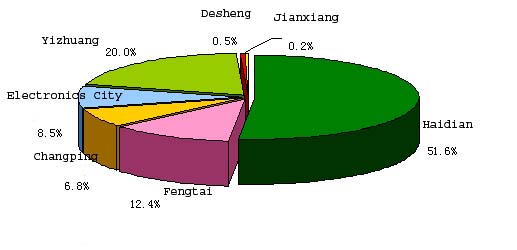
Zhongguancun Science and Technology Zone is composed of seven individual parks: Haidian Park, Fengtai Park, Changping Park, Electronics City, Yizhuang Park, Desheng Park, and Jianxiang Park. The following chart gives the breakdown of revenue by park.

Zhongguancun Science & Technology Zone 2006, January-June (Half Year) Economic Development Statistics (By Park)


2006 1/2 Year(% ZGC Revenue)2006 1/2 Year(Revenue in billion yuan)2005 1/2 Year(Revenue in billion yuan)
Haidian Park48.4124.393.2
Fengtai Park11.128.522.3
Changping Park6.717.212.5
Electronics City8.221.018.5
Yizhuang Park24.863.839.1
Desheng Park0.51.30.8
Jianxiang Park0.20.60.4
Total100.0256.6187.2

Zhongguancun 2006 Economic Statistics

Zhongguancun Science and Technology Zone
Management Committee

July 24, 2006

(Translated and adopted from Chinese, found at ZGC official government website, here, on October 29, 2006)

In the first half of the 2006 year, the total economy of the Zhongguancun Science and Technology Zone continued its high-speed, steady growth. The rate of growth of industrial production was relatively large and rate of growth of created export reserves slowed a little. There was steady growth in the amount of taxes paid, while newly recognized enterprises had clear decline. The entire economic trend was stable.

Zhongguancun Science & Technology Zone 2006, January-June (Half Year) Economic Statistics


2006 (1st Half)2005 (1st Half)% Increase
Newly Recognized Enterprises19162236-15.3
Revenue (billion yuan)256.6187.232.6
Total Industrial Production Value (billion yuan)141.7102.933.6
Taxes Paid (billion yuan)9.46.624.8
Exports Created (billion USD)9.05.468.1


The structure of total revenue is worthy of note. Sales of products accounted for 162.6 billion yuan or 63.4% of the total. Technology revenue was 35.3 billion yuan or 13.7% of total revenue. And other revenue accounted for 58.7 billion yuan or 22.9% of total revenue.

Thursday, September 07, 2006

New Oriental 新东方 IPO, Take Two

Of course, New Oriental sells dreams along with solid English teaching to children, college students, and young professionals. One of the major dreams that New Oriental peddles is chuguo 出国 or “leaving the country”, usually for New Zealand or Australia. Indeed, English education has this as one of its primary goals (and the ultimate endpoint, improving the self, making money, and becoming successful, is still achieved with chuguo). Many students, including one of my friends from 2000, swallow this dream whole and take classes, buy supplies, and pay tuition to New Oriental to achieve the dream. My friend from 2000 indeed did make it to New Zealand, although instead of a rigorous overseas education, he found a party-like atmosphere where rich children from China went to sow their oats.

A coin has two sides and education is a commodity, as difficult as it is to make teaching, learning, testing, and studying into a thing, much less a product or commodity. But that’s my two cents.

New Oriental Vignette

Along the Fourth Ring Road, to the east of Zhongguancun Avenue, is an enterprise that some of my friends only half-jokingly referred to as the most successful enterprise in Zhongguancun: New Oriental English-language school. On an otherwise inauspicious day in May, 2004, some poverty-line migrants, as they often do, were selling pirated English-language teaching and testing materials on bed sheets in front of New Oriental. As I passed the school I saw a sudden movement -- one of migrants grabbed his blanket and ran down a nearby alleyway. The others quickly followed. One unlucky migrant was too slow: several dozen CD-ROMs and teaching books spilled on the ground. He did not stop to retrieve them. Next, a police car and van pulled up, out of which four police officers emerged. They looked around, picked up the pirated CD-ROMs and books, and put them in the van.

Wondering what would happen next, I stopped and stood in front of the school. The police officers looked around and milled about for a few minutes. Then they drove off. Moments later, a young man standing in front of the school went to the corner of the alleyway, stood on top of a street post, and motioned down the alley. Minutes later, the migrants returned to the front of New Oriental to continue plying their pirated wares.

While piracy is ubiquitous in Zhongguancun, I argue here and elsewhere that neither ubiquity nor criminality is piracy’s greatest significance. Instead, one could even view these education material-peddling migrants as promulgaters of pedagogy.

I thought this vignette might be relevant to write about in light of today’s happenings.

新东方 (Xin Dongfang) or “New Oriental” Lists on NYSE

New Oriental is, according to Zhongguancun technocrati, the most successful enterprise in Zhongguancun. This is partially a joke since the most well-known companies in Zhongguancun are all technology companies: Sina, Lenovo, UFIDA, Founder. Further, Zhongguancun is a high-technology development zone, so the fact that New Oriental, an educational company that focuses on English, is so profitable is a little embarrassing but eminently understandable.

Peking University, Tsinghua University, Renmin University, and other famous universities, as well as national academies such as China Academy of Sciences and China Academy of Agricultural Sciences, are all located in Zhongguancun. The need for extracurricular education, such as that offered by New Oriental on nights and weekends, is one way to stay ahead at these education institutes.

Further, parents, with disposable income and no place to spend it, focus their financial might on singletons?the only children who have resulted from decades of the one-child, one-family policy. Singletons and New Oriental are another happy synergy, where children learn English and the school plies its wares.

Another level is migrants. Migrants come to Beijing, and to Zhongguancun in particular, for a variety of reasons. Mostly, it is to improve their lives, make some money to send back some, and become successful. One way to improve and succeed is to study English (or accounting). Hence, many migrants who are hesitant to spend their paltry pittances on consumer goods will instead opt for New Oriental hoping for a skill that will push them up and help them succeed.

All of these levels converge in Zhongguancun. Hence, despite the rise and fall of high-tech companies, the Internet wave, portals, and blogs, the one constant in Zhongguancun has been New Oriental. After so many years, a listing on the NYSE (and not tech-heavy Nasdaq) seems appropriate. New Oriental is reaching places that Sina and Lenovo perhaps cannot.

In any case, I welcome another Zhongguancun enterprise to the world.

Zhongguancun Enterprise Strikes Again

This morning, the most profitable, and some would say the most successful, enterprise in Zhongguancun listed on the New York Stock Exchange. The reasons for this, and a story about New Oriental piracy are forthcoming this evening… Stay tuned.

Friday, July 28, 2006

Article on Zhongguancun Published

After a long wait, I have finally published an article on Zhongguancun. It is not free, but fairly priced. If you have disposable income, feel free to purchase.

The article, "Technology as Practice in the Silicon Valley of China," is not focused solely on Zhongguancun. Instead it is about technology, and how viewing technology at the level of everyday life (the location of ethnography) yields insights into how technology comes to exist. I argue that companies and markets are necessary for technology to occur. In turn, technology's existence implies company and market.

This may seem to be a very specific definition of technology. However, I believe it to be general. For example, anthropologist Levi-Strauss analyzes a club that is used to hunt fish. The intricate, particular design and existence of the club is a objectification of the practice of killing fish (solving a problem) that comes into existence as a result of company (the people who make clubs and can make a living off that) and market (the demand for eating fish).

As you can see, this article is a little theoretical, and perhaps not suited to everyone. It does take place in Zhongguancun, and the three technology practices that I analyze come from my 2 years of fieldwork in Zhongguancun. In the article, I give some context to my fieldwork and describe the companies where I made observations. Technology, using my definition, is a key component of how Zhongguancun serves as a context for everyday life. Zhongguancun is also inseparable from technology practices that make it the Silicon Valley of China.

Eppur si mouve.

http://theuniversitypressjournals.cgpublisher.com/product/pub.42/prod.102

Wednesday, June 21, 2006

Newly Minted Ph.D. Returns from Beijing-Changzhou-Shanghai Trip

In late May and early June, 2006, I returned to visit all my old friends from Zhongguancun, the Silicon Valley of China, where I did the fieldwork that earned me a Ph.D. in anthropology of University of California, Santa Cruz, in cultural anthropology on June 16, 2006 [obligatory pat on own back].

Of more interest than me, of course, were the people and what they were doing. And, given the hyper-speed of life in China's city of cities (Beijing) and the hyper-ferocity of competition in a nominally socialist market economy, my experiences were fast and furious.

Upon returning to the IT/electronics markets of Zhongguancun to visit people from the Hilon photocopier company that I worked with for 6 months in 2004, I learned that the original company composed of 8 people had deconstructed in the literal sense. To visit my friends, I had to visit four different companies. The original company had met the fate of so many companies in Zhongguancun -- dissolution based on divergent interests and a sense that one can make more money if one goes out on one's own (despite the fact that the perennial topic of conversation among Zhongguancun IT/electronics markets bosses is the microscopic profit margins on sales).

One of the former members of the company I worked with in the markets, who I shall call Young Guo, is a fax machine specialist. I have seen him completely dissemble a laser fax machine in search of a problem. His hands are dirty, his manners uncouth, and his language peppered with expletives. But he is a dear friend and key source for the inner workings of the IT/electronics markets.

Young Guo had moved to Dinghao Electronics Market and rented a 6 square meter, glass-enclosed shop on the second floor underground at Dinghao. He continued to sell photocopiers, fax machines, and perform service and maintenance, as he had in the former company.

Besides catching up on the two years that had elapsed since we had worked to together, I had sought out Young Guo with a goal: I had a Cingular Nokia phone that I wanted to use in China. Who can de-encrypt this phone, I asked, so I can use it in China. Apparently, phones sold in the U.S. only work in two frequencies, and they need to be de-encrypted with a special device to work in China. If it could be done and had to do with IT or electronics, I knew, it could be done in Zhongguancun's IT/electronics markets.

Young Guo's neighbor, it turns out, could provide the service (not herself, mind you, but she had a connection with another guy who could). Before she de-encrypted, she warned me that there was a possibility that the phone might simply short-circuit. Since I had no other use for the phone, I was willing to accept the risk.

When Young Guo and I returned from lunch, the neighbor approached beaming with success. The phone de-encryption had worked! She then asked for payment: 80 yuan (10 USD). I paid it.

In a few minutes, Young Guo led me away to smoke and chat with a few friends in another neighboring store. Young Guo left to check on his store and then returned with a smile on his face. "She thought you were a customer," he grinned. "She tried to give me 20 yuan as a profit." Young Guo explained that since the woman thought I was just a friendly customer, not an ethnographic insider, she should make a profit for Young Guo and then give it to him -- her fee was waived for similar fees made when she introduced customers to Young Guo and he paid her part of the profit.

The woman insisted on keeping the 20 yuan so Young Guo tried to give me 20 yuan. I refused. Although I am sufficiently worried about losing 20 yuan, I did not think it important enough to have Young Guo pay it out of his pocket. I chalked it up to "tuition". At least it would make a good blog entry, I reasoned.

In the IT/electronics markets, life, exchange, reciprocity, and technology all go on through the social forms of entrepreneurs and companies. This is modern China, and especially urban, IT/electronics market China. But these relationships, between neighboring stores, stores and customers, and de-encryption devices, go beyond a particular time and place. I would even hypothesize their existence throughout China, even its villages and hinterlands.

And by the way, I didn't see the state in these markets. So much for totalitarianism.

Tuesday, May 23, 2006

How Lenovo is Like Microsoft and Dell

According to several managers I know in Zhongguancun, they are running a Linux software company that is mostly funded by China's government in order to create products (such as word processing software, operating systems) and services (such as training). Yet most entrepreneurs in Zhongguancun and, indeed, in China do not like this MO. Why? China's entrepreneurs love the market. The market, not the government, should decide who makes money, what is a good product, and the trends in industry.

It is quite comical, then, that Representative Frank Wolf (a Republican no less), Larry Wortzel, and Michael Wessel have determined that using Lenovo's computers in the State Department is unwise, due to potential espionage concerns. The reason the State Department chose Lenovo in the first place is that there is a competitive bid process, and Lenovo's computers were the cheapest, the fastest, and the best value. In times of budget deficit and current account deficit (not to mention trade deficit), the State Department should be commended. But it is being condemned.

Back to China. Why would the government fund its own Linux-based operating system and programs? Among many reasons, one is that there are existing fears about Microsoft and Dell, both American companies, that their software code and computers, respectively, contain secret code and hardware that will email secrets to Washington. What a far-fetched, feckless fear, I used to think.

As much as I relish being able to excoriate a member of the Republican party, it is disconcerting that Representative Wolf is so ready to capitulate to xenophobic fears. The market is not a panacea. Zhongguancun entrepreneurs' faith in competition and free market values is certainly idealistic. Yet, as one entrepreneur I interviewed once told me, "the government is a little slow. Making a PC these days is like making a TV -- it is not technology. If the government knew that, they wouldn't place so much importance on Lenovo." At the time, he referred to China. Now, I refer to the U.S.

Friday, March 10, 2006

Zhongguancun Zone 2005 Economic Indicators

Zhongguancun Science & Technology Zone 2005 Summary of Economic Development

Department of Science & Technology
Torch High Technology Industry Development Center

February 27, 2006

http://www.chinatorch.gov.cn/dtxw/dtxw_News_info_26421.aspx

2005 was the year after Zhongguancun Science & Technology Zone “Five Year Phase of Taking the Platform.” Various construction projects of the Zone achieved substantial results: economic development grew at a fast yet stable rate; in total economic quantity, indicators doubled from 2001; revenue in technology-industry-trade broke 480 billion yuan; industrial production and foreign currency increased mightily; there was a steady increase in the amount of taxes paid; the development trends in key industries was stable; core enterprises had a positive total development form; and there was a beneficial increase in key projects of the central area.

Zhongguancun Science& Technology Zone 2005 Economic Development Status
(Preliminary Statistics)


20052004% Increase
Newly Recognized Enterprises4,4344,2663.9
Revenue (billion yuan)481.9369.230.5
Total Industrial Production Value (billion yuan)255.2187.636.0
Taxes Paid (billion yuan)16.814.218.1
Exports Created (billion USD)9.05.468.1


Separated according to Zhongguancun’s individual Parks, Haidian Park had an estimated total revenue of 248.5 billion yuan, Fengtai Park a total revenue of 60.0 billion yuan, Changping Yuan an estimated total revenue of 23.7 billion yuan, Electronics City an estimated total revenue of 41.0 billion yuan, Yizhuang an estimated revenue of 96.5 billion yuan, Desheng Park 2.22 billion yuan, and Jianxiang Park 1.0 billion yuan. Compared to last year, aside from Changping Park whose growth rate declined to 4.8%, other Parks all grew at a rate of 18% or higher, and Yizhuang Science and Technology Park grew at the highest rate: 97.1%.

Thursday, February 16, 2006

Doesn't It Seem Strange?

The U.S. Congress is holding hearings on Google, Yahoo, and MSN aiding the Chinese government in the suppression of human rights.

But on January 25, 2006, an article in the New York Times reported that Google is refusing to execute a subpoena by the U.S. government to surveil the Internet searches of U.S. citizens.

The justification given, by both U.S. and China governments, is that they are trying to find information on illegal activities, including terrorism and pornography, to ensure the stability and security of its citizens. What are the differences?

In the U.S., terrorism is defined mostly as those related to al Qaeda, which attacked the United States by hijacking airplanes.

In China, terrorism is defined mostly as those related to Falungong, which is a cult that tricks its followers into giving up their money, any sort of health care, and even into self-immolation.

Both governments want to protect the safety and security of their citizens. They do it by filtering web sites and search results. That is right, the U.S. government also blocks web sites if it deems those sites to violate the laws of the U.S. government, including not only terrorists but intellectual property scofflaws.

Why should "free speech" be able to trump the human rights to safety and security? The publication of cartoons of Prophet Muhammad has caused several people to die, while others have been injured. Perhaps the publishers did not know this would be the result. Hence they are not technically liable for the results. But it is clear that publication is not necessarily a right guaranteed under "free speech". In fact, the New York Times did not publish the cartoons. Perhaps Congress will convene a hearing to investigate why the Times censored its reporting? Unlikely.

There is something more going on in the House Subcommittee on Africa, Global Human Rights and International Operations, lead by Christopher Smith. I implore Congress to stop these hearings. Instead, criticize the very fact of surveillance and filtering, and investigate the U.S. Justice Department and the myriad local police forces that have used the Internet to put people in jail. There are more than a few.

Why should Google, Yahoo, and Microsoft be held at fault for complying with the same exact laws that exist in both China and the U.S. -- the right for society to be free from intimidation, violence, and attack?

Wednesday, February 15, 2006

Hypocrisy of Chris Smith

In the New York Times today, an article reported that Congress, and specifically the House, is excoriating tech companies Google, Yahoo, Microsoft, and Cisco for their business operations in China.

From my perspective, I wonder why it is that most mp3 files, movies, and software can be distributed freely over the internet in China but not in the U.S. Those sites in China, infringing on copyrights of the record industry, Hollywood, and Silicon Valley (among others), are frequently blocked by the U.S. government. Yup, your right to access free content on the internet is restricted not in China but in the U.S. Is this a violation of your human rights?

The companies that go to China are bridging a divide. Gaining access to China, remember, only occurred in the past 25 years.

When I lived in China in 2000, the New York Times was blocked. Then, one day, it wasn't. People in China can and do read about news from the U.S. They know much more about current events in the U.S. then we do about events over there. They also know about censorship.

I understand the argument that "freedom of expression" is a fundamental right in the U.S. Indeed, without it, I might not be able to write this weblog. However, in China, it is not a fundamental right. This is not a human rights question, but a question of the relation between ideal and real.

Schooling and health care are universal human rights. But many people in the U.S. do not have health care. Does that mean the U.S. government is violating our human rights? If I have to work after high school instead of going to college in order to pay for food and living expenses, is that a violation of my human rights by the U.S. government?

In China, many pornographic and cult websites are blocked. Most news sites are not. Does this make a difference? Doesn't it matter what is blocked? Falungong is legally a (terrorist) cult in China, so its websites are blocked. Is this unreasonable?

In China, everyone knows the law is not to openly criticize the government in print, since everyone does it in daily conversation everyday (if you don't believe it, learn Chinese, go to Beijing, and take a few cab rides -- there are quite a few disgruntled cabbies). When a blogger violates this law, he/she must pay the price, just as anyone else does.

In reality, media changes nothing. The law is still the law.

If the House of Representatives wants to challenge Chinese law, that is fine. But why on earth are Google, Yahoo, Microsoft, and Cisco being raked over the coals? Aren't we violating their (human) right to do business?

Sunday, February 05, 2006

Superbowl Halftime

First, go Sprint. Halftime show brought to you by Sprint (together with Nextel). Buy a cell phone!

Also, I created a Chen Chunxian entry at Wikipedia. Check it out if you get a chance.

Professor Chen was an amazing person. We all know about Liu Chuanzhi, one of the founders and current Chairman of Lenovo. But Liu Chuanzhi walked down the road blazed by the late Professor Chen in 1980. Without him, Liu Chuanzhi would still be trying to determine who to promote in the cadre department of the (China) Academy of Sciences.

I think it would be worthwhile to create a Chen Chunxian monument in Zhongguancun -- probably in front of Hilon Market, the busiest market in Zhongguancun.

I met Professor Chen on October 26, 2003. Professor Chen passed away on August 11, 2004. Perhaps I was the last foreigner to visit him. Perhaps Professor Chen created the idea that high-tech, technology, was a project aimed to get science out of the lab and into people's hands. Professor Chen created the idea that a privately-run enterprise in China could use scientists to make money. Making money put technology on the street, with all the civil society and life-improvement consequences that therewith.

I will miss him.

No Negative News

I just wanted to report that there is no negative news from China today.

Perhaps it is a general trend in news reporting, or simply the nature of news itself, but the vast majority of news I get about China these days (and for the past 5 years) is negative. I do not question the "objectivity" of reporting, just the selection of topics. The site I get a lot of China stuff from is China Digital Times. Check it out for daily emails on China-related reports in the media. But let's think a little before we report another peasant uprising.

In one of the best classes I ever took, Maria Lepowsky taught us about "Anthropology by Women" (my emphasis). Although the class was 30-3 female-male, the focus was not on feminism per se, but on women: what women anthropologists have done, their influence in the field. Focusing on women is a choice of topic. Feminism, properly speaking, attacks domination and defines mainstream institutions as patriarchical. Instead, in Lepowsky's class at the University of Wisconsin, we chose to study the work of women.

In Zhongguancun, a million wonderful things happen everyday. Computers are assembled, migrants learn technical skills to fix photocopiers, the local government assists new start-up companies, and people live their lives. Most of them are happy. There is no ominous specter looming over everything.

Of course, Zhongguancun is not the countryside, which is the new "darling" of Western media reports on China. But Zhongguancun is surrounded by the countryside. In my travails in and around Zhongguancun, I had occasion to visit the countryside many times. What I encountered was not anger over land grabs or vitriol at the government. Instead, people yearned for a bigger piece of the pie. At the same time, countryfolk are extremely cognizant that life in China today is better, far better, than it was in the past.

The point of this post is only to draw attention to the fact that all the news out of China today is extremely negative. Perhaps happy peasants are not very interesting. But they far outnumber the unhappy ones. Is there a motive in reporting the bad rather than the good?

Thursday, November 03, 2005

盗版还是垄断?

((The following article is a translation of my August 16 post on Piracy and Microsoft, found here. I re-wrote it in Simplified Chinese for more general dispersal. ))

by Tyler Rooker -- re-written in Chinese

在 中关村,“中国硅谷”,Windows XP的盗版到处都有。这是谁都知道的。不管是农村来到电子城门外的流动人口,还是在柜台装机的人,许多人都不花钱用XP。什么原因啊?价格。正版 Windows要两千多元(250美元)。盗版只需要6元。但是,这样的情况到底损害还是支持微软的操作系统的垄断?

“枪打出头鸟”是中 文的一句俗语。对百度,用友,联想等大公司来讲如果它们用盗版,就会引起微软在法院里的“枪”。但是,对微软来讲,枪打那些今天在明天不在的流动人口,这 么做有什么好处呢?没有。这些流动人口只会被政府的工商部门抓了,罚款,然后遣送回家。而这些被罚的款都属于北京市的政府。那么,盗版怎么帮助微软呢?

从 一个观点来看,答案是,只要盗版在中国继续存在,微软就可以维持它在中国的垄断。现在中国没有操作系统。连计划中的系统都没有。为什么?因为一出来,也会 被盗版。盗版削弱微软,但是同时也削弱中国想要开发自己的操作系统的企业家们。如果中国操作系统是200元(25美元)的话,就可以让那些企业家们获得足 够的利润和投资收益。那样一来,为什么金山(中国的微软)不去开发呢?盗版。

在中国,盗版确实把微软的一部分利润窃取掉。但我想强调是,微软也是从盗版行为获得某些好处和利润。如果没有盗版的话,中国的操作系统就会像毛主席所说的“百花齐放,百家争鸣”。最终,那些系统会削弱或结束微软的操作系统的垄断。

下次微软抱怨中国的盗版时,注意他们找什么理由。在中关村4/5的电脑是品牌机,用的都是正版。1/5是DIY装机的,用的是盗版。那么,微软丢失了还是获得了利润呢?