Of course, New Oriental sells dreams along with solid English teaching to children, college students, and young professionals. One of the major dreams that New Oriental peddles is chuguo 出国 or “leaving the country”, usually for New Zealand or Australia. Indeed, English education has this as one of its primary goals (and the ultimate endpoint, improving the self, making money, and becoming successful, is still achieved with chuguo). Many students, including one of my friends from 2000, swallow this dream whole and take classes, buy supplies, and pay tuition to New Oriental to achieve the dream. My friend from 2000 indeed did make it to New Zealand, although instead of a rigorous overseas education, he found a party-like atmosphere where rich children from China went to sow their oats.
A coin has two sides and education is a commodity, as difficult as it is to make teaching, learning, testing, and studying into a thing, much less a product or commodity. But that’s my two cents.
Thursday, September 07, 2006
New Oriental Vignette
Along the Fourth Ring Road, to the east of Zhongguancun Avenue, is an enterprise that some of my friends only half-jokingly referred to as the most successful enterprise in Zhongguancun: New Oriental English-language school. On an otherwise inauspicious day in May, 2004, some poverty-line migrants, as they often do, were selling pirated English-language teaching and testing materials on bed sheets in front of New Oriental. As I passed the school I saw a sudden movement -- one of migrants grabbed his blanket and ran down a nearby alleyway. The others quickly followed. One unlucky migrant was too slow: several dozen CD-ROMs and teaching books spilled on the ground. He did not stop to retrieve them. Next, a police car and van pulled up, out of which four police officers emerged. They looked around, picked up the pirated CD-ROMs and books, and put them in the van.
Wondering what would happen next, I stopped and stood in front of the school. The police officers looked around and milled about for a few minutes. Then they drove off. Moments later, a young man standing in front of the school went to the corner of the alleyway, stood on top of a street post, and motioned down the alley. Minutes later, the migrants returned to the front of New Oriental to continue plying their pirated wares.
While piracy is ubiquitous in Zhongguancun, I argue here and elsewhere that neither ubiquity nor criminality is piracy’s greatest significance. Instead, one could even view these education material-peddling migrants as promulgaters of pedagogy.
I thought this vignette might be relevant to write about in light of today’s happenings.
Wondering what would happen next, I stopped and stood in front of the school. The police officers looked around and milled about for a few minutes. Then they drove off. Moments later, a young man standing in front of the school went to the corner of the alleyway, stood on top of a street post, and motioned down the alley. Minutes later, the migrants returned to the front of New Oriental to continue plying their pirated wares.
While piracy is ubiquitous in Zhongguancun, I argue here and elsewhere that neither ubiquity nor criminality is piracy’s greatest significance. Instead, one could even view these education material-peddling migrants as promulgaters of pedagogy.
I thought this vignette might be relevant to write about in light of today’s happenings.
新东方 (Xin Dongfang) or “New Oriental” Lists on NYSE
New Oriental is, according to Zhongguancun technocrati, the most successful enterprise in Zhongguancun. This is partially a joke since the most well-known companies in Zhongguancun are all technology companies: Sina, Lenovo, UFIDA, Founder. Further, Zhongguancun is a high-technology development zone, so the fact that New Oriental, an educational company that focuses on English, is so profitable is a little embarrassing but eminently understandable.
Peking University, Tsinghua University, Renmin University, and other famous universities, as well as national academies such as China Academy of Sciences and China Academy of Agricultural Sciences, are all located in Zhongguancun. The need for extracurricular education, such as that offered by New Oriental on nights and weekends, is one way to stay ahead at these education institutes.
Further, parents, with disposable income and no place to spend it, focus their financial might on singletons?the only children who have resulted from decades of the one-child, one-family policy. Singletons and New Oriental are another happy synergy, where children learn English and the school plies its wares.
Another level is migrants. Migrants come to Beijing, and to Zhongguancun in particular, for a variety of reasons. Mostly, it is to improve their lives, make some money to send back some, and become successful. One way to improve and succeed is to study English (or accounting). Hence, many migrants who are hesitant to spend their paltry pittances on consumer goods will instead opt for New Oriental hoping for a skill that will push them up and help them succeed.
All of these levels converge in Zhongguancun. Hence, despite the rise and fall of high-tech companies, the Internet wave, portals, and blogs, the one constant in Zhongguancun has been New Oriental. After so many years, a listing on the NYSE (and not tech-heavy Nasdaq) seems appropriate. New Oriental is reaching places that Sina and Lenovo perhaps cannot.
In any case, I welcome another Zhongguancun enterprise to the world.
Peking University, Tsinghua University, Renmin University, and other famous universities, as well as national academies such as China Academy of Sciences and China Academy of Agricultural Sciences, are all located in Zhongguancun. The need for extracurricular education, such as that offered by New Oriental on nights and weekends, is one way to stay ahead at these education institutes.
Further, parents, with disposable income and no place to spend it, focus their financial might on singletons?the only children who have resulted from decades of the one-child, one-family policy. Singletons and New Oriental are another happy synergy, where children learn English and the school plies its wares.
Another level is migrants. Migrants come to Beijing, and to Zhongguancun in particular, for a variety of reasons. Mostly, it is to improve their lives, make some money to send back some, and become successful. One way to improve and succeed is to study English (or accounting). Hence, many migrants who are hesitant to spend their paltry pittances on consumer goods will instead opt for New Oriental hoping for a skill that will push them up and help them succeed.
All of these levels converge in Zhongguancun. Hence, despite the rise and fall of high-tech companies, the Internet wave, portals, and blogs, the one constant in Zhongguancun has been New Oriental. After so many years, a listing on the NYSE (and not tech-heavy Nasdaq) seems appropriate. New Oriental is reaching places that Sina and Lenovo perhaps cannot.
In any case, I welcome another Zhongguancun enterprise to the world.
Zhongguancun Enterprise Strikes Again
This morning, the most profitable, and some would say the most successful, enterprise in Zhongguancun listed on the New York Stock Exchange. The reasons for this, and a story about New Oriental piracy are forthcoming this evening… Stay tuned.
Friday, July 28, 2006
Article on Zhongguancun Published
After a long wait, I have finally published an article on Zhongguancun. It is not free, but fairly priced. If you have disposable income, feel free to purchase.
The article, "Technology as Practice in the Silicon Valley of China," is not focused solely on Zhongguancun. Instead it is about technology, and how viewing technology at the level of everyday life (the location of ethnography) yields insights into how technology comes to exist. I argue that companies and markets are necessary for technology to occur. In turn, technology's existence implies company and market.
This may seem to be a very specific definition of technology. However, I believe it to be general. For example, anthropologist Levi-Strauss analyzes a club that is used to hunt fish. The intricate, particular design and existence of the club is a objectification of the practice of killing fish (solving a problem) that comes into existence as a result of company (the people who make clubs and can make a living off that) and market (the demand for eating fish).
As you can see, this article is a little theoretical, and perhaps not suited to everyone. It does take place in Zhongguancun, and the three technology practices that I analyze come from my 2 years of fieldwork in Zhongguancun. In the article, I give some context to my fieldwork and describe the companies where I made observations. Technology, using my definition, is a key component of how Zhongguancun serves as a context for everyday life. Zhongguancun is also inseparable from technology practices that make it the Silicon Valley of China.
Eppur si mouve.
http://theuniversitypressjournals.cgpublisher.com/product/pub.42/prod.102
The article, "Technology as Practice in the Silicon Valley of China," is not focused solely on Zhongguancun. Instead it is about technology, and how viewing technology at the level of everyday life (the location of ethnography) yields insights into how technology comes to exist. I argue that companies and markets are necessary for technology to occur. In turn, technology's existence implies company and market.
This may seem to be a very specific definition of technology. However, I believe it to be general. For example, anthropologist Levi-Strauss analyzes a club that is used to hunt fish. The intricate, particular design and existence of the club is a objectification of the practice of killing fish (solving a problem) that comes into existence as a result of company (the people who make clubs and can make a living off that) and market (the demand for eating fish).
As you can see, this article is a little theoretical, and perhaps not suited to everyone. It does take place in Zhongguancun, and the three technology practices that I analyze come from my 2 years of fieldwork in Zhongguancun. In the article, I give some context to my fieldwork and describe the companies where I made observations. Technology, using my definition, is a key component of how Zhongguancun serves as a context for everyday life. Zhongguancun is also inseparable from technology practices that make it the Silicon Valley of China.
Eppur si mouve.
http://theuniversitypressjournals.cgpublisher.com/product/pub.42/prod.102
Wednesday, June 21, 2006
Newly Minted Ph.D. Returns from Beijing-Changzhou-Shanghai Trip
In late May and early June, 2006, I returned to visit all my old friends from Zhongguancun, the Silicon Valley of China, where I did the fieldwork that earned me a Ph.D. in anthropology of University of California, Santa Cruz, in cultural anthropology on June 16, 2006 [obligatory pat on own back].
Of more interest than me, of course, were the people and what they were doing. And, given the hyper-speed of life in China's city of cities (Beijing) and the hyper-ferocity of competition in a nominally socialist market economy, my experiences were fast and furious.
Upon returning to the IT/electronics markets of Zhongguancun to visit people from the Hilon photocopier company that I worked with for 6 months in 2004, I learned that the original company composed of 8 people had deconstructed in the literal sense. To visit my friends, I had to visit four different companies. The original company had met the fate of so many companies in Zhongguancun -- dissolution based on divergent interests and a sense that one can make more money if one goes out on one's own (despite the fact that the perennial topic of conversation among Zhongguancun IT/electronics markets bosses is the microscopic profit margins on sales).
One of the former members of the company I worked with in the markets, who I shall call Young Guo, is a fax machine specialist. I have seen him completely dissemble a laser fax machine in search of a problem. His hands are dirty, his manners uncouth, and his language peppered with expletives. But he is a dear friend and key source for the inner workings of the IT/electronics markets.
Young Guo had moved to Dinghao Electronics Market and rented a 6 square meter, glass-enclosed shop on the second floor underground at Dinghao. He continued to sell photocopiers, fax machines, and perform service and maintenance, as he had in the former company.
Besides catching up on the two years that had elapsed since we had worked to together, I had sought out Young Guo with a goal: I had a Cingular Nokia phone that I wanted to use in China. Who can de-encrypt this phone, I asked, so I can use it in China. Apparently, phones sold in the U.S. only work in two frequencies, and they need to be de-encrypted with a special device to work in China. If it could be done and had to do with IT or electronics, I knew, it could be done in Zhongguancun's IT/electronics markets.
Young Guo's neighbor, it turns out, could provide the service (not herself, mind you, but she had a connection with another guy who could). Before she de-encrypted, she warned me that there was a possibility that the phone might simply short-circuit. Since I had no other use for the phone, I was willing to accept the risk.
When Young Guo and I returned from lunch, the neighbor approached beaming with success. The phone de-encryption had worked! She then asked for payment: 80 yuan (10 USD). I paid it.
In a few minutes, Young Guo led me away to smoke and chat with a few friends in another neighboring store. Young Guo left to check on his store and then returned with a smile on his face. "She thought you were a customer," he grinned. "She tried to give me 20 yuan as a profit." Young Guo explained that since the woman thought I was just a friendly customer, not an ethnographic insider, she should make a profit for Young Guo and then give it to him -- her fee was waived for similar fees made when she introduced customers to Young Guo and he paid her part of the profit.
The woman insisted on keeping the 20 yuan so Young Guo tried to give me 20 yuan. I refused. Although I am sufficiently worried about losing 20 yuan, I did not think it important enough to have Young Guo pay it out of his pocket. I chalked it up to "tuition". At least it would make a good blog entry, I reasoned.
In the IT/electronics markets, life, exchange, reciprocity, and technology all go on through the social forms of entrepreneurs and companies. This is modern China, and especially urban, IT/electronics market China. But these relationships, between neighboring stores, stores and customers, and de-encryption devices, go beyond a particular time and place. I would even hypothesize their existence throughout China, even its villages and hinterlands.
And by the way, I didn't see the state in these markets. So much for totalitarianism.
Of more interest than me, of course, were the people and what they were doing. And, given the hyper-speed of life in China's city of cities (Beijing) and the hyper-ferocity of competition in a nominally socialist market economy, my experiences were fast and furious.
Upon returning to the IT/electronics markets of Zhongguancun to visit people from the Hilon photocopier company that I worked with for 6 months in 2004, I learned that the original company composed of 8 people had deconstructed in the literal sense. To visit my friends, I had to visit four different companies. The original company had met the fate of so many companies in Zhongguancun -- dissolution based on divergent interests and a sense that one can make more money if one goes out on one's own (despite the fact that the perennial topic of conversation among Zhongguancun IT/electronics markets bosses is the microscopic profit margins on sales).
One of the former members of the company I worked with in the markets, who I shall call Young Guo, is a fax machine specialist. I have seen him completely dissemble a laser fax machine in search of a problem. His hands are dirty, his manners uncouth, and his language peppered with expletives. But he is a dear friend and key source for the inner workings of the IT/electronics markets.
Young Guo had moved to Dinghao Electronics Market and rented a 6 square meter, glass-enclosed shop on the second floor underground at Dinghao. He continued to sell photocopiers, fax machines, and perform service and maintenance, as he had in the former company.
Besides catching up on the two years that had elapsed since we had worked to together, I had sought out Young Guo with a goal: I had a Cingular Nokia phone that I wanted to use in China. Who can de-encrypt this phone, I asked, so I can use it in China. Apparently, phones sold in the U.S. only work in two frequencies, and they need to be de-encrypted with a special device to work in China. If it could be done and had to do with IT or electronics, I knew, it could be done in Zhongguancun's IT/electronics markets.
Young Guo's neighbor, it turns out, could provide the service (not herself, mind you, but she had a connection with another guy who could). Before she de-encrypted, she warned me that there was a possibility that the phone might simply short-circuit. Since I had no other use for the phone, I was willing to accept the risk.
When Young Guo and I returned from lunch, the neighbor approached beaming with success. The phone de-encryption had worked! She then asked for payment: 80 yuan (10 USD). I paid it.
In a few minutes, Young Guo led me away to smoke and chat with a few friends in another neighboring store. Young Guo left to check on his store and then returned with a smile on his face. "She thought you were a customer," he grinned. "She tried to give me 20 yuan as a profit." Young Guo explained that since the woman thought I was just a friendly customer, not an ethnographic insider, she should make a profit for Young Guo and then give it to him -- her fee was waived for similar fees made when she introduced customers to Young Guo and he paid her part of the profit.
The woman insisted on keeping the 20 yuan so Young Guo tried to give me 20 yuan. I refused. Although I am sufficiently worried about losing 20 yuan, I did not think it important enough to have Young Guo pay it out of his pocket. I chalked it up to "tuition". At least it would make a good blog entry, I reasoned.
In the IT/electronics markets, life, exchange, reciprocity, and technology all go on through the social forms of entrepreneurs and companies. This is modern China, and especially urban, IT/electronics market China. But these relationships, between neighboring stores, stores and customers, and de-encryption devices, go beyond a particular time and place. I would even hypothesize their existence throughout China, even its villages and hinterlands.
And by the way, I didn't see the state in these markets. So much for totalitarianism.
Tuesday, May 23, 2006
How Lenovo is Like Microsoft and Dell
According to several managers I know in Zhongguancun, they are running a Linux software company that is mostly funded by China's government in order to create products (such as word processing software, operating systems) and services (such as training). Yet most entrepreneurs in Zhongguancun and, indeed, in China do not like this MO. Why? China's entrepreneurs love the market. The market, not the government, should decide who makes money, what is a good product, and the trends in industry.
It is quite comical, then, that Representative Frank Wolf (a Republican no less), Larry Wortzel, and Michael Wessel have determined that using Lenovo's computers in the State Department is unwise, due to potential espionage concerns. The reason the State Department chose Lenovo in the first place is that there is a competitive bid process, and Lenovo's computers were the cheapest, the fastest, and the best value. In times of budget deficit and current account deficit (not to mention trade deficit), the State Department should be commended. But it is being condemned.
Back to China. Why would the government fund its own Linux-based operating system and programs? Among many reasons, one is that there are existing fears about Microsoft and Dell, both American companies, that their software code and computers, respectively, contain secret code and hardware that will email secrets to Washington. What a far-fetched, feckless fear, I used to think.
As much as I relish being able to excoriate a member of the Republican party, it is disconcerting that Representative Wolf is so ready to capitulate to xenophobic fears. The market is not a panacea. Zhongguancun entrepreneurs' faith in competition and free market values is certainly idealistic. Yet, as one entrepreneur I interviewed once told me, "the government is a little slow. Making a PC these days is like making a TV -- it is not technology. If the government knew that, they wouldn't place so much importance on Lenovo." At the time, he referred to China. Now, I refer to the U.S.
It is quite comical, then, that Representative Frank Wolf (a Republican no less), Larry Wortzel, and Michael Wessel have determined that using Lenovo's computers in the State Department is unwise, due to potential espionage concerns. The reason the State Department chose Lenovo in the first place is that there is a competitive bid process, and Lenovo's computers were the cheapest, the fastest, and the best value. In times of budget deficit and current account deficit (not to mention trade deficit), the State Department should be commended. But it is being condemned.
Back to China. Why would the government fund its own Linux-based operating system and programs? Among many reasons, one is that there are existing fears about Microsoft and Dell, both American companies, that their software code and computers, respectively, contain secret code and hardware that will email secrets to Washington. What a far-fetched, feckless fear, I used to think.
As much as I relish being able to excoriate a member of the Republican party, it is disconcerting that Representative Wolf is so ready to capitulate to xenophobic fears. The market is not a panacea. Zhongguancun entrepreneurs' faith in competition and free market values is certainly idealistic. Yet, as one entrepreneur I interviewed once told me, "the government is a little slow. Making a PC these days is like making a TV -- it is not technology. If the government knew that, they wouldn't place so much importance on Lenovo." At the time, he referred to China. Now, I refer to the U.S.
Friday, March 10, 2006
Zhongguancun Zone 2005 Economic Indicators
Zhongguancun Science & Technology Zone 2005 Summary of Economic Development
Department of Science & Technology
Torch High Technology Industry Development Center
February 27, 2006
http://www.chinatorch.gov.cn/dtxw/dtxw_News_info_26421.aspx
2005 was the year after Zhongguancun Science & Technology Zone “Five Year Phase of Taking the Platform.” Various construction projects of the Zone achieved substantial results: economic development grew at a fast yet stable rate; in total economic quantity, indicators doubled from 2001; revenue in technology-industry-trade broke 480 billion yuan; industrial production and foreign currency increased mightily; there was a steady increase in the amount of taxes paid; the development trends in key industries was stable; core enterprises had a positive total development form; and there was a beneficial increase in key projects of the central area.
Zhongguancun Science& Technology Zone 2005 Economic Development Status
(Preliminary Statistics)
(Preliminary Statistics)
| 2005 | 2004 | % Increase | ||
| Newly Recognized Enterprises | 4,434 | 4,266 | 3.9 | |
| Revenue (billion yuan) | 481.9 | 369.2 | 30.5 | |
| Total Industrial Production Value (billion yuan) | 255.2 | 187.6 | 36.0 | |
| Taxes Paid (billion yuan) | 16.8 | 14.2 | 18.1 | |
| Exports Created (billion USD) | 9.0 | 5.4 | 68.1 |
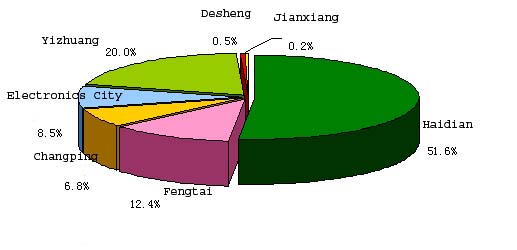
Separated according to Zhongguancun’s individual Parks, Haidian Park had an estimated total revenue of 248.5 billion yuan, Fengtai Park a total revenue of 60.0 billion yuan, Changping Yuan an estimated total revenue of 23.7 billion yuan, Electronics City an estimated total revenue of 41.0 billion yuan, Yizhuang an estimated revenue of 96.5 billion yuan, Desheng Park 2.22 billion yuan, and Jianxiang Park 1.0 billion yuan. Compared to last year, aside from Changping Park whose growth rate declined to 4.8%, other Parks all grew at a rate of 18% or higher, and Yizhuang Science and Technology Park grew at the highest rate: 97.1%.
Thursday, February 16, 2006
Doesn't It Seem Strange?
The U.S. Congress is holding hearings on Google, Yahoo, and MSN aiding the Chinese government in the suppression of human rights.
But on January 25, 2006, an article in the New York Times reported that Google is refusing to execute a subpoena by the U.S. government to surveil the Internet searches of U.S. citizens.
The justification given, by both U.S. and China governments, is that they are trying to find information on illegal activities, including terrorism and pornography, to ensure the stability and security of its citizens. What are the differences?
In the U.S., terrorism is defined mostly as those related to al Qaeda, which attacked the United States by hijacking airplanes.
In China, terrorism is defined mostly as those related to Falungong, which is a cult that tricks its followers into giving up their money, any sort of health care, and even into self-immolation.
Both governments want to protect the safety and security of their citizens. They do it by filtering web sites and search results. That is right, the U.S. government also blocks web sites if it deems those sites to violate the laws of the U.S. government, including not only terrorists but intellectual property scofflaws.
Why should "free speech" be able to trump the human rights to safety and security? The publication of cartoons of Prophet Muhammad has caused several people to die, while others have been injured. Perhaps the publishers did not know this would be the result. Hence they are not technically liable for the results. But it is clear that publication is not necessarily a right guaranteed under "free speech". In fact, the New York Times did not publish the cartoons. Perhaps Congress will convene a hearing to investigate why the Times censored its reporting? Unlikely.
There is something more going on in the House Subcommittee on Africa, Global Human Rights and International Operations, lead by Christopher Smith. I implore Congress to stop these hearings. Instead, criticize the very fact of surveillance and filtering, and investigate the U.S. Justice Department and the myriad local police forces that have used the Internet to put people in jail. There are more than a few.
Why should Google, Yahoo, and Microsoft be held at fault for complying with the same exact laws that exist in both China and the U.S. -- the right for society to be free from intimidation, violence, and attack?
But on January 25, 2006, an article in the New York Times reported that Google is refusing to execute a subpoena by the U.S. government to surveil the Internet searches of U.S. citizens.
The justification given, by both U.S. and China governments, is that they are trying to find information on illegal activities, including terrorism and pornography, to ensure the stability and security of its citizens. What are the differences?
In the U.S., terrorism is defined mostly as those related to al Qaeda, which attacked the United States by hijacking airplanes.
In China, terrorism is defined mostly as those related to Falungong, which is a cult that tricks its followers into giving up their money, any sort of health care, and even into self-immolation.
Both governments want to protect the safety and security of their citizens. They do it by filtering web sites and search results. That is right, the U.S. government also blocks web sites if it deems those sites to violate the laws of the U.S. government, including not only terrorists but intellectual property scofflaws.
Why should "free speech" be able to trump the human rights to safety and security? The publication of cartoons of Prophet Muhammad has caused several people to die, while others have been injured. Perhaps the publishers did not know this would be the result. Hence they are not technically liable for the results. But it is clear that publication is not necessarily a right guaranteed under "free speech". In fact, the New York Times did not publish the cartoons. Perhaps Congress will convene a hearing to investigate why the Times censored its reporting? Unlikely.
There is something more going on in the House Subcommittee on Africa, Global Human Rights and International Operations, lead by Christopher Smith. I implore Congress to stop these hearings. Instead, criticize the very fact of surveillance and filtering, and investigate the U.S. Justice Department and the myriad local police forces that have used the Internet to put people in jail. There are more than a few.
Why should Google, Yahoo, and Microsoft be held at fault for complying with the same exact laws that exist in both China and the U.S. -- the right for society to be free from intimidation, violence, and attack?
Wednesday, February 15, 2006
Hypocrisy of Chris Smith
In the New York Times today, an article reported that Congress, and specifically the House, is excoriating tech companies Google, Yahoo, Microsoft, and Cisco for their business operations in China.
From my perspective, I wonder why it is that most mp3 files, movies, and software can be distributed freely over the internet in China but not in the U.S. Those sites in China, infringing on copyrights of the record industry, Hollywood, and Silicon Valley (among others), are frequently blocked by the U.S. government. Yup, your right to access free content on the internet is restricted not in China but in the U.S. Is this a violation of your human rights?
The companies that go to China are bridging a divide. Gaining access to China, remember, only occurred in the past 25 years.
When I lived in China in 2000, the New York Times was blocked. Then, one day, it wasn't. People in China can and do read about news from the U.S. They know much more about current events in the U.S. then we do about events over there. They also know about censorship.
I understand the argument that "freedom of expression" is a fundamental right in the U.S. Indeed, without it, I might not be able to write this weblog. However, in China, it is not a fundamental right. This is not a human rights question, but a question of the relation between ideal and real.
Schooling and health care are universal human rights. But many people in the U.S. do not have health care. Does that mean the U.S. government is violating our human rights? If I have to work after high school instead of going to college in order to pay for food and living expenses, is that a violation of my human rights by the U.S. government?
In China, many pornographic and cult websites are blocked. Most news sites are not. Does this make a difference? Doesn't it matter what is blocked? Falungong is legally a (terrorist) cult in China, so its websites are blocked. Is this unreasonable?
In China, everyone knows the law is not to openly criticize the government in print, since everyone does it in daily conversation everyday (if you don't believe it, learn Chinese, go to Beijing, and take a few cab rides -- there are quite a few disgruntled cabbies). When a blogger violates this law, he/she must pay the price, just as anyone else does.
In reality, media changes nothing. The law is still the law.
If the House of Representatives wants to challenge Chinese law, that is fine. But why on earth are Google, Yahoo, Microsoft, and Cisco being raked over the coals? Aren't we violating their (human) right to do business?
From my perspective, I wonder why it is that most mp3 files, movies, and software can be distributed freely over the internet in China but not in the U.S. Those sites in China, infringing on copyrights of the record industry, Hollywood, and Silicon Valley (among others), are frequently blocked by the U.S. government. Yup, your right to access free content on the internet is restricted not in China but in the U.S. Is this a violation of your human rights?
The companies that go to China are bridging a divide. Gaining access to China, remember, only occurred in the past 25 years.
When I lived in China in 2000, the New York Times was blocked. Then, one day, it wasn't. People in China can and do read about news from the U.S. They know much more about current events in the U.S. then we do about events over there. They also know about censorship.
I understand the argument that "freedom of expression" is a fundamental right in the U.S. Indeed, without it, I might not be able to write this weblog. However, in China, it is not a fundamental right. This is not a human rights question, but a question of the relation between ideal and real.
Schooling and health care are universal human rights. But many people in the U.S. do not have health care. Does that mean the U.S. government is violating our human rights? If I have to work after high school instead of going to college in order to pay for food and living expenses, is that a violation of my human rights by the U.S. government?
In China, many pornographic and cult websites are blocked. Most news sites are not. Does this make a difference? Doesn't it matter what is blocked? Falungong is legally a (terrorist) cult in China, so its websites are blocked. Is this unreasonable?
In China, everyone knows the law is not to openly criticize the government in print, since everyone does it in daily conversation everyday (if you don't believe it, learn Chinese, go to Beijing, and take a few cab rides -- there are quite a few disgruntled cabbies). When a blogger violates this law, he/she must pay the price, just as anyone else does.
In reality, media changes nothing. The law is still the law.
If the House of Representatives wants to challenge Chinese law, that is fine. But why on earth are Google, Yahoo, Microsoft, and Cisco being raked over the coals? Aren't we violating their (human) right to do business?
Sunday, February 05, 2006
Superbowl Halftime
First, go Sprint. Halftime show brought to you by Sprint (together with Nextel). Buy a cell phone!
Also, I created a Chen Chunxian entry at Wikipedia. Check it out if you get a chance.
Professor Chen was an amazing person. We all know about Liu Chuanzhi, one of the founders and current Chairman of Lenovo. But Liu Chuanzhi walked down the road blazed by the late Professor Chen in 1980. Without him, Liu Chuanzhi would still be trying to determine who to promote in the cadre department of the (China) Academy of Sciences.
I think it would be worthwhile to create a Chen Chunxian monument in Zhongguancun -- probably in front of Hilon Market, the busiest market in Zhongguancun.
I met Professor Chen on October 26, 2003. Professor Chen passed away on August 11, 2004. Perhaps I was the last foreigner to visit him. Perhaps Professor Chen created the idea that high-tech, technology, was a project aimed to get science out of the lab and into people's hands. Professor Chen created the idea that a privately-run enterprise in China could use scientists to make money. Making money put technology on the street, with all the civil society and life-improvement consequences that therewith.
I will miss him.
Also, I created a Chen Chunxian entry at Wikipedia. Check it out if you get a chance.
Professor Chen was an amazing person. We all know about Liu Chuanzhi, one of the founders and current Chairman of Lenovo. But Liu Chuanzhi walked down the road blazed by the late Professor Chen in 1980. Without him, Liu Chuanzhi would still be trying to determine who to promote in the cadre department of the (China) Academy of Sciences.
I think it would be worthwhile to create a Chen Chunxian monument in Zhongguancun -- probably in front of Hilon Market, the busiest market in Zhongguancun.
I met Professor Chen on October 26, 2003. Professor Chen passed away on August 11, 2004. Perhaps I was the last foreigner to visit him. Perhaps Professor Chen created the idea that high-tech, technology, was a project aimed to get science out of the lab and into people's hands. Professor Chen created the idea that a privately-run enterprise in China could use scientists to make money. Making money put technology on the street, with all the civil society and life-improvement consequences that therewith.
I will miss him.
No Negative News
I just wanted to report that there is no negative news from China today.
Perhaps it is a general trend in news reporting, or simply the nature of news itself, but the vast majority of news I get about China these days (and for the past 5 years) is negative. I do not question the "objectivity" of reporting, just the selection of topics. The site I get a lot of China stuff from is China Digital Times. Check it out for daily emails on China-related reports in the media. But let's think a little before we report another peasant uprising.
In one of the best classes I ever took, Maria Lepowsky taught us about "Anthropology by Women" (my emphasis). Although the class was 30-3 female-male, the focus was not on feminism per se, but on women: what women anthropologists have done, their influence in the field. Focusing on women is a choice of topic. Feminism, properly speaking, attacks domination and defines mainstream institutions as patriarchical. Instead, in Lepowsky's class at the University of Wisconsin, we chose to study the work of women.
In Zhongguancun, a million wonderful things happen everyday. Computers are assembled, migrants learn technical skills to fix photocopiers, the local government assists new start-up companies, and people live their lives. Most of them are happy. There is no ominous specter looming over everything.
Of course, Zhongguancun is not the countryside, which is the new "darling" of Western media reports on China. But Zhongguancun is surrounded by the countryside. In my travails in and around Zhongguancun, I had occasion to visit the countryside many times. What I encountered was not anger over land grabs or vitriol at the government. Instead, people yearned for a bigger piece of the pie. At the same time, countryfolk are extremely cognizant that life in China today is better, far better, than it was in the past.
The point of this post is only to draw attention to the fact that all the news out of China today is extremely negative. Perhaps happy peasants are not very interesting. But they far outnumber the unhappy ones. Is there a motive in reporting the bad rather than the good?
Perhaps it is a general trend in news reporting, or simply the nature of news itself, but the vast majority of news I get about China these days (and for the past 5 years) is negative. I do not question the "objectivity" of reporting, just the selection of topics. The site I get a lot of China stuff from is China Digital Times. Check it out for daily emails on China-related reports in the media. But let's think a little before we report another peasant uprising.
In one of the best classes I ever took, Maria Lepowsky taught us about "Anthropology by Women" (my emphasis). Although the class was 30-3 female-male, the focus was not on feminism per se, but on women: what women anthropologists have done, their influence in the field. Focusing on women is a choice of topic. Feminism, properly speaking, attacks domination and defines mainstream institutions as patriarchical. Instead, in Lepowsky's class at the University of Wisconsin, we chose to study the work of women.
In Zhongguancun, a million wonderful things happen everyday. Computers are assembled, migrants learn technical skills to fix photocopiers, the local government assists new start-up companies, and people live their lives. Most of them are happy. There is no ominous specter looming over everything.
Of course, Zhongguancun is not the countryside, which is the new "darling" of Western media reports on China. But Zhongguancun is surrounded by the countryside. In my travails in and around Zhongguancun, I had occasion to visit the countryside many times. What I encountered was not anger over land grabs or vitriol at the government. Instead, people yearned for a bigger piece of the pie. At the same time, countryfolk are extremely cognizant that life in China today is better, far better, than it was in the past.
The point of this post is only to draw attention to the fact that all the news out of China today is extremely negative. Perhaps happy peasants are not very interesting. But they far outnumber the unhappy ones. Is there a motive in reporting the bad rather than the good?
Thursday, November 03, 2005
盗版还是垄断?
((The following article is a translation of my August 16 post on Piracy and Microsoft, found here. I re-wrote it in Simplified Chinese for more general dispersal. ))
by Tyler Rooker -- re-written in Chinese
在 中关村,“中国硅谷”,Windows XP的盗版到处都有。这是谁都知道的。不管是农村来到电子城门外的流动人口,还是在柜台装机的人,许多人都不花钱用XP。什么原因啊?价格。正版 Windows要两千多元(250美元)。盗版只需要6元。但是,这样的情况到底损害还是支持微软的操作系统的垄断?
“枪打出头鸟”是中 文的一句俗语。对百度,用友,联想等大公司来讲如果它们用盗版,就会引起微软在法院里的“枪”。但是,对微软来讲,枪打那些今天在明天不在的流动人口,这 么做有什么好处呢?没有。这些流动人口只会被政府的工商部门抓了,罚款,然后遣送回家。而这些被罚的款都属于北京市的政府。那么,盗版怎么帮助微软呢?
从 一个观点来看,答案是,只要盗版在中国继续存在,微软就可以维持它在中国的垄断。现在中国没有操作系统。连计划中的系统都没有。为什么?因为一出来,也会 被盗版。盗版削弱微软,但是同时也削弱中国想要开发自己的操作系统的企业家们。如果中国操作系统是200元(25美元)的话,就可以让那些企业家们获得足 够的利润和投资收益。那样一来,为什么金山(中国的微软)不去开发呢?盗版。
在中国,盗版确实把微软的一部分利润窃取掉。但我想强调是,微软也是从盗版行为获得某些好处和利润。如果没有盗版的话,中国的操作系统就会像毛主席所说的“百花齐放,百家争鸣”。最终,那些系统会削弱或结束微软的操作系统的垄断。
下次微软抱怨中国的盗版时,注意他们找什么理由。在中关村4/5的电脑是品牌机,用的都是正版。1/5是DIY装机的,用的是盗版。那么,微软丢失了还是获得了利润呢?
by Tyler Rooker -- re-written in Chinese
在 中关村,“中国硅谷”,Windows XP的盗版到处都有。这是谁都知道的。不管是农村来到电子城门外的流动人口,还是在柜台装机的人,许多人都不花钱用XP。什么原因啊?价格。正版 Windows要两千多元(250美元)。盗版只需要6元。但是,这样的情况到底损害还是支持微软的操作系统的垄断?
“枪打出头鸟”是中 文的一句俗语。对百度,用友,联想等大公司来讲如果它们用盗版,就会引起微软在法院里的“枪”。但是,对微软来讲,枪打那些今天在明天不在的流动人口,这 么做有什么好处呢?没有。这些流动人口只会被政府的工商部门抓了,罚款,然后遣送回家。而这些被罚的款都属于北京市的政府。那么,盗版怎么帮助微软呢?
从 一个观点来看,答案是,只要盗版在中国继续存在,微软就可以维持它在中国的垄断。现在中国没有操作系统。连计划中的系统都没有。为什么?因为一出来,也会 被盗版。盗版削弱微软,但是同时也削弱中国想要开发自己的操作系统的企业家们。如果中国操作系统是200元(25美元)的话,就可以让那些企业家们获得足 够的利润和投资收益。那样一来,为什么金山(中国的微软)不去开发呢?盗版。
在中国,盗版确实把微软的一部分利润窃取掉。但我想强调是,微软也是从盗版行为获得某些好处和利润。如果没有盗版的话,中国的操作系统就会像毛主席所说的“百花齐放,百家争鸣”。最终,那些系统会削弱或结束微软的操作系统的垄断。
下次微软抱怨中国的盗版时,注意他们找什么理由。在中关村4/5的电脑是品牌机,用的都是正版。1/5是DIY装机的,用的是盗版。那么,微软丢失了还是获得了利润呢?


Tuesday, November 01, 2005
Wikipedia Zhongguancun Entry Updated
I have added some information to the Wikipedia entry for Zhongguancun. It is currently listed under "Zhong Guan Cun," which makes sense because the characters in the Chinese name are three separate ones (see title of this blog).
The current address is:
Wikipedia Zhongguancun
Check it out.
Also, writing up a general introduction to Zhongguancun has made me recall my interview with Chen Chunxian, the China Academy of Sciences (CAS) member who was the first person to think of a Silicon Valley in China. Chen Chunxian was a plasma physicist at CAS until he quit to start a company. He is known in Zhongguancun as "the first person to eat crab" (第一吃螃蟹的人), meaning that dared to try something that looked horrible on the outside but is great once you try it. He passed away one year ago. I will post a future blog about him and his courageous work to set up a company and transfer scientific results into technology that could be used. He really is some one who should be remembered.
The current address is:
Wikipedia Zhongguancun
Check it out.
Also, writing up a general introduction to Zhongguancun has made me recall my interview with Chen Chunxian, the China Academy of Sciences (CAS) member who was the first person to think of a Silicon Valley in China. Chen Chunxian was a plasma physicist at CAS until he quit to start a company. He is known in Zhongguancun as "the first person to eat crab" (第一吃螃蟹的人), meaning that dared to try something that looked horrible on the outside but is great once you try it. He passed away one year ago. I will post a future blog about him and his courageous work to set up a company and transfer scientific results into technology that could be used. He really is some one who should be remembered.
Sunday, October 30, 2005
Zhongguancun is the "China Valley"
With the increasing influence of China -- as global partner or global threat -- Zhongguancun, the Silicon Valley of China, will continue to attract attention from the West. In this vein, I propose that Zhongguancun be known in English as "China Valley" to attest to both its China origin and its purported affinity with Silicon Valley, California.
In the Bay Area and environs, along with those who claim to be insiders to it, Silicon Valley is known as the "Valley". Therefore the nickname given to the China Valley should come naturally.
In addition, this should remove the difficult surrounding the pronunciation of Zhongguancun -- Zhong, guan, cun -- which is quite diffiult for Westerners, and the awkwardness of ZGC, an acronym. "The Silicon Valley of China" works well as a name, but it is too wordy to use in ordinary conversation.
I would be curious as to opinions on this name. It seems to work well. Let me know your ideas.
In the Bay Area and environs, along with those who claim to be insiders to it, Silicon Valley is known as the "Valley". Therefore the nickname given to the China Valley should come naturally.
In addition, this should remove the difficult surrounding the pronunciation of Zhongguancun -- Zhong, guan, cun -- which is quite diffiult for Westerners, and the awkwardness of ZGC, an acronym. "The Silicon Valley of China" works well as a name, but it is too wordy to use in ordinary conversation.
I would be curious as to opinions on this name. It seems to work well. Let me know your ideas.
Thursday, October 20, 2005
Problem Solving
Over the course of 2 years doing research on the Silicon Valley of China, I encountered numerous problems that required skill, perseverance, networking, and creativity to solve. The difficulties ranged from mundane?finding a university and professor to sponsor my research?to the cultural?convincing top executives at Beijing UFSoft Software Corporation that I could conduct objective research on their company operations. There were several different skill sets that I drew on to solve these problems. Besides my knowledge of Chinese culture and language, I sized up the situations, networked with relevant people, and persevered in accomplishing my goals to solve these problems.
To conduct research in Chinese companies is no simple feat. The first step was to obtain a Chinese visa for one year at a university in order to gain sponsorship both for the visa process and for future inquires into my research goals. Using leads from my research committee, I contact two Peking University professors. I also renewed a connection with the Peking University Mandarin Center, where I undergone advanced language training two years pervious. I arranged for one of the professors to write a sponsoring letter which I had delivered to the Mandarin Center. In two weeks, using money I had sent with application, an express letter containing my visa documents arrived. Facing the initial problems of visa and sponsorship, I moved quickly and arranged to have necessary documents delivered and a enrollment letter at Peking University prepared in a total time of less than one month. I was on my way to Beijing to study companies in the Silicon Valley of China.
Two of the three companies were relatively small, with less than ten people. In those two cases, access was not a problem since no proprietary technology or influential information was at stake. Despite this fact, two problems arose: one was how I would introduce myself to these companies; two was how I would explain my research so that I could both gain necessary access to managers and workers and guarantee the participants not to violate their rights as human subjects. I relied on an old friend to introduce me to companies that he knew beforehand. This method guaranteed a minimum of trust, which I subsequently used to explain my research project on the successes of China’s Silicon Valley, a patriotic thing for people in China. This cast my research in a positive light, which facilitated access to managers and workers, as well as revealing the nature of my research that protected individual’s rights of whether or not to participate.
Finally, the biggest challenge I faced in my research was how to get access to a large, prestigious company. I spent one month contacting friends, advisors, and government officials I knew to help me. On a hunch, I emailed to head of Beijing UFSoft for an interview. After the interview, over diner, I mentioned that I needed on the ground information about a large company in China. The executive suggested that I work at UFSoft. This was the opportunity I had hoped for but, knowing how China business and culture work, I could not suggest it myself. I allowed the executive to think that it was he who had thought of the idea. My initiative in setting up the interview, calling on friends to guarantee my character, as well as understanding Chinese culture and this executive’s personality lead to a solution and my access to UFSoft for research. I accomplished my goals through initiative, skill, networking and perseverance that are reflected most poignantly in this example.
To conduct research in Chinese companies is no simple feat. The first step was to obtain a Chinese visa for one year at a university in order to gain sponsorship both for the visa process and for future inquires into my research goals. Using leads from my research committee, I contact two Peking University professors. I also renewed a connection with the Peking University Mandarin Center, where I undergone advanced language training two years pervious. I arranged for one of the professors to write a sponsoring letter which I had delivered to the Mandarin Center. In two weeks, using money I had sent with application, an express letter containing my visa documents arrived. Facing the initial problems of visa and sponsorship, I moved quickly and arranged to have necessary documents delivered and a enrollment letter at Peking University prepared in a total time of less than one month. I was on my way to Beijing to study companies in the Silicon Valley of China.
Two of the three companies were relatively small, with less than ten people. In those two cases, access was not a problem since no proprietary technology or influential information was at stake. Despite this fact, two problems arose: one was how I would introduce myself to these companies; two was how I would explain my research so that I could both gain necessary access to managers and workers and guarantee the participants not to violate their rights as human subjects. I relied on an old friend to introduce me to companies that he knew beforehand. This method guaranteed a minimum of trust, which I subsequently used to explain my research project on the successes of China’s Silicon Valley, a patriotic thing for people in China. This cast my research in a positive light, which facilitated access to managers and workers, as well as revealing the nature of my research that protected individual’s rights of whether or not to participate.
Finally, the biggest challenge I faced in my research was how to get access to a large, prestigious company. I spent one month contacting friends, advisors, and government officials I knew to help me. On a hunch, I emailed to head of Beijing UFSoft for an interview. After the interview, over diner, I mentioned that I needed on the ground information about a large company in China. The executive suggested that I work at UFSoft. This was the opportunity I had hoped for but, knowing how China business and culture work, I could not suggest it myself. I allowed the executive to think that it was he who had thought of the idea. My initiative in setting up the interview, calling on friends to guarantee my character, as well as understanding Chinese culture and this executive’s personality lead to a solution and my access to UFSoft for research. I accomplished my goals through initiative, skill, networking and perseverance that are reflected most poignantly in this example.
Interpersonal Skills
There is one particular time person in particular, the first six months of 2004, when my interpersonal skills were tested and displayed to the extreme. During this period, I spent half a year amongst the migrants and would-be entrepreneurs who work in the IT/electronics markets of Zhongguancun, the Silicon Valley of China. These women and men are not the lofty paragon of technology virtuosity that China’s Silicon Valley is meant to contain. Instead, they are an eclectic population, coming from all corners of China with education ranging from middle school drop-out to technical community college graduate. Living and working amongst them, I experienced tests of my ideas of privacy, rudeness, hygiene. My responses, from anger and frustration to compassion and understanding, reveal the greatest extent to which my interpersonal skills can be stretched.
Experiencing IT/electronics markets for the first, one sees chaos. Boxes seem to move up and down the crowded aisles by themselves, while people spit, smoke, and throw trash outside their stores, regardless of who may be outside or walking by. But even more poignant for an American are people’s eyes. Glances become stares and shopping for a new printer is more like being an animal in a mobile zoo. Hearing only “ha-lou!” (the Chinese transliteration of hello), one quickly tires of these markets.
But I wanted to understand the mixture of technology and business in China. So, on a daily basis, I came to the markets, meeting people store after store, who constantly drew attention to my appearance, my race, and my nationality. In turn, I emphasized politeness. I observed every courtesy and custom that I knew of. Some one once joked with me that I was “more Chinese than the Chinese.” The manners I displayed had been honed over previous years of experience with China.
Store by store and counter by counter, I used my difference to create similarity. Slowly, a group of regular store owners, colleagues, and even friends emerged against the backdrop of chaos and stares. Addressing elder migrants as “big brother,” adopting Chinese mannerisms and postures, and generally being sympathetic to their opinions (at least initially), I was able to enter circles that exist in the IT/electronics markets.
What is even more significance, however, is that I gained an audience. While I learned about China’s technology migrants and emergent market economy, I also was able to speak to a receptive and interested audience about the reasons for the Iraq war, the meaning of human rights, and how unions are formed. Had I not gained trust and feelings of commonality, I be ignored and dismissed. Instead, open dialogue and thoughtful discussion took place as a result of adapting to behaviors, customs, and forms of address that made the IT/electronics migrants of the Silicon Valley of China comfortable.
Experiencing IT/electronics markets for the first, one sees chaos. Boxes seem to move up and down the crowded aisles by themselves, while people spit, smoke, and throw trash outside their stores, regardless of who may be outside or walking by. But even more poignant for an American are people’s eyes. Glances become stares and shopping for a new printer is more like being an animal in a mobile zoo. Hearing only “ha-lou!” (the Chinese transliteration of hello), one quickly tires of these markets.
But I wanted to understand the mixture of technology and business in China. So, on a daily basis, I came to the markets, meeting people store after store, who constantly drew attention to my appearance, my race, and my nationality. In turn, I emphasized politeness. I observed every courtesy and custom that I knew of. Some one once joked with me that I was “more Chinese than the Chinese.” The manners I displayed had been honed over previous years of experience with China.
Store by store and counter by counter, I used my difference to create similarity. Slowly, a group of regular store owners, colleagues, and even friends emerged against the backdrop of chaos and stares. Addressing elder migrants as “big brother,” adopting Chinese mannerisms and postures, and generally being sympathetic to their opinions (at least initially), I was able to enter circles that exist in the IT/electronics markets.
What is even more significance, however, is that I gained an audience. While I learned about China’s technology migrants and emergent market economy, I also was able to speak to a receptive and interested audience about the reasons for the Iraq war, the meaning of human rights, and how unions are formed. Had I not gained trust and feelings of commonality, I be ignored and dismissed. Instead, open dialogue and thoughtful discussion took place as a result of adapting to behaviors, customs, and forms of address that made the IT/electronics migrants of the Silicon Valley of China comfortable.
Sunday, September 18, 2005
Science City Plans Approved
Beijing City Land Plans Approved
Zhongguancun “Science City” Demarcated
August 24, 2005 on http://house.tom.com
Source: Beijing Business Today (http://www.bjbusiness.com)
Original website in Chinese: http://house.news.tom.com/1056/2005824-45625.html
Translated by Tyler Rooker on September 18, 2005 for http://chinasilicon.blogspot.com
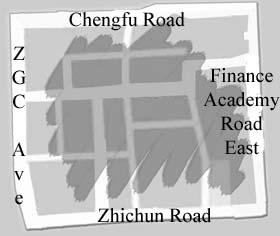
Sketch of “Science City” in Zhongguancun by Zhao Zhenchao
This reporter learned yesterday from the Beijing City Planning Committee that the specific plans for Zhongguancun Science City had been approved. The vice-president of the company responsible for first level developing of the Science City, Yang Jianping of Zhongguancun Science City Construction Limited Liability Company, said: the specific plans were put in place in order to increase benefits from development.
According to the City Planning Committee, the Zhongguancun Science City will run from Chengfu Road in the north to Zhichun Road in the south; from Zhongguancun Avenue (Baiyi Road) in the west to Finance & Economics Academy Road East in the east. This is a total of 331.43 hectares of total land use. The planned total construction is 4.42 million square meters, of which 2.65 million square meters will be set aside for construction by China Academy of Sciences. Insiders pointed out that this is possibly the largest scale land use in a city ever.
The Planning Committee also emphasized that it must combine demands for city landscape, environment, and land development so that multiple levels of construction involved in the Zhongguancun Science City are addressed. Also, it must clarify the plans for a green land system in the Zhongguancun Science City, plans for road and traffic systems, and plans for public facilities and government offices.
The Area is Equivalent to 1.5 Summer Palaces
(See here for an English tour of Beijing’s Summer Palace)
Zhongguancun Science City is located along the development axis of the Zhongguancun Science & Technology Zone. It has an area of over 330 hectares, equivalent to the area of 1.5 Summer Places. Together with Peking University, Tsinghua University and the Zhongguancun western high-tech commercial center, it forms the Zhongguancun Science & Technology Zone, Haidian Park central region. Zhongguancun There are over 25 national research institutes and over 50 national keystone laboratories and development laboratories. There are 16,000 science and technology workers of whom there are over 100 from the two Academies of Sciences. The Science City of Zhongguancun also has a large number of competitive high-tech enterprises. You could say that Zhongguancun Science City is the national treasure of high-tech talent in China.
Tardiness in Constructing the Science City
This reporter learned from related departments that as early as 6 years ago, China Academy of Sciences (CAS) had made plans to construct the largest science city in all of East Asia. In 1999, the city of Beijing and other science and technology departments decided to use a period of 10 years to build Zhongguancun Science City into a world-class science and technology zone.
In 2001, the city of Beijing government and CAS joined hands to plan the science city. In that year, on November 8, the Beijing Zhongguancun Science City Construction Limited Liability Company was formally established, which showed that the Zhongguancun Science City had entered the practical phase. And yet, over three years have passed and construction on the Science City remains in initial stages. Up until yesterday, formal permission to go ahead with the plans by the City Planning Committee had not been given.
The vice-president of the Beijing Zhongguancun Science City Construction Limited Liability Company, Yang Jianping analyzed the situation. He said that the tardiness of construction had three aspects. First, this area totals 331.43 hectares, equivalent to 1.5 Summer Palaces, and so there are difficulties in development. Second, the structure of Zone construction is complex ? the Science City encompasses 25 national research institutes and over 50 national keystone laboratories and development laboratories. These cannot be demolished so demolishment must be carried out carefully to avoid damage. Finally, there have been other problems with demolition that have not been solved.
The Rise of a High-Tech Economic Center
With the issuing of specific plans for the Science City, clear progress has been made in developing it. Specific plans have been integrated with overall city planning and specific district planning. Land use and use intensity in the specific districts has been clarified, while roads and engineering angles as well as environment protection have been integrated. These plans are the direct result of management by the City Planning Committee.
The Beijing Zhongguancun Science City Construction Limited Liability Company vice-president, Yang Jianping, explained it this way: the specific plans have been issues to demarcate the basic height, area, and roads to be encompasses. This is the backdrop to the next stage in planning.
The Beijing Zhongguancun Science City Construction Limited Liability Company has taken on the responsibility of constructing the Zhongguancun Science City High-Tech Industry Innovation Incubator. Starting with land development in 2001, today it has basically completed organization of this land. The Zhongguancun Science City High-Tech Industry Innovation Incubator will take up 33.6 hectares, with the basic function of transferring the scientific research capabilities of the Science City into industrial capabilities. It will become a well-know collaboration and information exchange center domestically and internationally. The Innovation Incubator will also be a high-tech and product training center. According to the plans, within 5-7 years, the Innovation Incubator will take advantage of a perfected infrastructure construction, advanced information networks, lively enterprises, beautiful environment, dense cultural atmosphere, and a modern feel -- a world-class science and technology zone.
President of China area for the Kotler Marketing Company (USA) Tiger Cao, real-estate investment consultant, said in an interview that: “This region has great development future. It will become concentrated area of high- and medium-level income groups. At the same time, because of Zhongguancun’s attractiveness, it will create a large movement of people. Over the next few years, this place will become like the CBD District -- an economic center with high-tech as its focus.
Zhongguancun “Science City” Demarcated
August 24, 2005 on http://house.tom.com
Source: Beijing Business Today (http://www.bjbusiness.com)
Original website in Chinese: http://house.news.tom.com/1056/2005824-45625.html
Translated by Tyler Rooker on September 18, 2005 for http://chinasilicon.blogspot.com
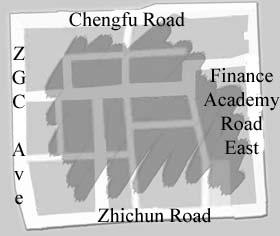
Sketch of “Science City” in Zhongguancun by Zhao Zhenchao
This reporter learned yesterday from the Beijing City Planning Committee that the specific plans for Zhongguancun Science City had been approved. The vice-president of the company responsible for first level developing of the Science City, Yang Jianping of Zhongguancun Science City Construction Limited Liability Company, said: the specific plans were put in place in order to increase benefits from development.
According to the City Planning Committee, the Zhongguancun Science City will run from Chengfu Road in the north to Zhichun Road in the south; from Zhongguancun Avenue (Baiyi Road) in the west to Finance & Economics Academy Road East in the east. This is a total of 331.43 hectares of total land use. The planned total construction is 4.42 million square meters, of which 2.65 million square meters will be set aside for construction by China Academy of Sciences. Insiders pointed out that this is possibly the largest scale land use in a city ever.
The Planning Committee also emphasized that it must combine demands for city landscape, environment, and land development so that multiple levels of construction involved in the Zhongguancun Science City are addressed. Also, it must clarify the plans for a green land system in the Zhongguancun Science City, plans for road and traffic systems, and plans for public facilities and government offices.
The Area is Equivalent to 1.5 Summer Palaces
(See here for an English tour of Beijing’s Summer Palace)
Zhongguancun Science City is located along the development axis of the Zhongguancun Science & Technology Zone. It has an area of over 330 hectares, equivalent to the area of 1.5 Summer Places. Together with Peking University, Tsinghua University and the Zhongguancun western high-tech commercial center, it forms the Zhongguancun Science & Technology Zone, Haidian Park central region. Zhongguancun There are over 25 national research institutes and over 50 national keystone laboratories and development laboratories. There are 16,000 science and technology workers of whom there are over 100 from the two Academies of Sciences. The Science City of Zhongguancun also has a large number of competitive high-tech enterprises. You could say that Zhongguancun Science City is the national treasure of high-tech talent in China.
Tardiness in Constructing the Science City
This reporter learned from related departments that as early as 6 years ago, China Academy of Sciences (CAS) had made plans to construct the largest science city in all of East Asia. In 1999, the city of Beijing and other science and technology departments decided to use a period of 10 years to build Zhongguancun Science City into a world-class science and technology zone.
In 2001, the city of Beijing government and CAS joined hands to plan the science city. In that year, on November 8, the Beijing Zhongguancun Science City Construction Limited Liability Company was formally established, which showed that the Zhongguancun Science City had entered the practical phase. And yet, over three years have passed and construction on the Science City remains in initial stages. Up until yesterday, formal permission to go ahead with the plans by the City Planning Committee had not been given.
The vice-president of the Beijing Zhongguancun Science City Construction Limited Liability Company, Yang Jianping analyzed the situation. He said that the tardiness of construction had three aspects. First, this area totals 331.43 hectares, equivalent to 1.5 Summer Palaces, and so there are difficulties in development. Second, the structure of Zone construction is complex ? the Science City encompasses 25 national research institutes and over 50 national keystone laboratories and development laboratories. These cannot be demolished so demolishment must be carried out carefully to avoid damage. Finally, there have been other problems with demolition that have not been solved.
The Rise of a High-Tech Economic Center
With the issuing of specific plans for the Science City, clear progress has been made in developing it. Specific plans have been integrated with overall city planning and specific district planning. Land use and use intensity in the specific districts has been clarified, while roads and engineering angles as well as environment protection have been integrated. These plans are the direct result of management by the City Planning Committee.
The Beijing Zhongguancun Science City Construction Limited Liability Company vice-president, Yang Jianping, explained it this way: the specific plans have been issues to demarcate the basic height, area, and roads to be encompasses. This is the backdrop to the next stage in planning.
The Beijing Zhongguancun Science City Construction Limited Liability Company has taken on the responsibility of constructing the Zhongguancun Science City High-Tech Industry Innovation Incubator. Starting with land development in 2001, today it has basically completed organization of this land. The Zhongguancun Science City High-Tech Industry Innovation Incubator will take up 33.6 hectares, with the basic function of transferring the scientific research capabilities of the Science City into industrial capabilities. It will become a well-know collaboration and information exchange center domestically and internationally. The Innovation Incubator will also be a high-tech and product training center. According to the plans, within 5-7 years, the Innovation Incubator will take advantage of a perfected infrastructure construction, advanced information networks, lively enterprises, beautiful environment, dense cultural atmosphere, and a modern feel -- a world-class science and technology zone.
President of China area for the Kotler Marketing Company (USA) Tiger Cao, real-estate investment consultant, said in an interview that: “This region has great development future. It will become concentrated area of high- and medium-level income groups. At the same time, because of Zhongguancun’s attractiveness, it will create a large movement of people. Over the next few years, this place will become like the CBD District -- an economic center with high-tech as its focus.
Tuesday, September 06, 2005
DIY & Potatoes
DIY -- A Plate of Delicious Sliced Potatoes
Gao Mingxin
http://www.i-chinatrade.com/zgc/zuan/diy.htm
Another person has come to Zhongguancun. In the blink of a eye, he has bought a screwdriver. A few hours later, he has collected a CPU, a monitor, memory and other Zhongguancun “specialties” to take back home. This is “DIY” a newly fashionable phrase in the Village (Zhongguancun’s nickname). Put simply, DIY (“do-it-yourself”) is a three-way contest between a screwdriver, a computer case, and a monitor. “Cultured people” in the Village explain the phrase this way: “DIY is directly oriented to a large number of users. DIY assembly is the bridge between users and component sellers. DIY is the delight of component manufacturers; DIY is the scourge of complete system manufactures.”
A few days ago, the computer industry branch of the Beijing Electronics Merchant Association united with several dozen Zhongguancun brand-name computer manufacturers to present the government with a report. In the report, the licensed, brand-name manufacturers expressed outrage -- how is it that any Tom, Dick, and Harry can make computer assembly into a puzzle game? The report showed that the DIY market is in chaos: some DIY-ers are not licensed but still assemble computers at large scales. This phenomenon should be clamped down upon, the report recommended. There is no quality assurance for DIY products without licenses, and the safety of products is suspect.
Although the word DIY is of recent origin, the history of assembling computers in the Village is a long one. To learn how to eat sliced potatoes with vinegar and sugar, is it necessary to learn how to DIY potatoes? No, and yet many people who use computers start to learn about them from DIY. If a citizen wants to start work but has no abilities, he/she is not even given a chance to DIY a wooden stool in middle school crafts class. But if one’s dream is to use a computer -- starting an information revolution in the household -- one can actually use this passion to DIY computers. Part of the motivation for DIY comes from the simple fact that a portion of price goes to software makers; another portion goes to workers at the computer company. Men and women of the world prefer to grasp their pocketbooks tightly. Even if the memory strip doesn’t exactly fit in the motherboard, it is of little consequence -- take it and your screwdriver back to Zhongguancun.
In practice, those who can DIY potatoes but not computers need not worry since there are specialists in Zhongguancun’s electronics markets who DIY machines just like putting together a puzzle -- sticking together the different pieces and finishing within an hour. For the thousands of computer market counters, DIY is a Zhongguancun specialty. But the happiness of this bunch has become the worry of that bunch. The DIY business makes brand name manufacturers furrow their brows. With the appearance of licenses, brand names are more authentic and trustworthy. As the Chinese proverb foretells, “the army of the emperor will always defeat a lesser known army.” But history has shown that Li Zicheng still was able to occupy Beijing. The DIY-ers in the present component market are still riding high. “On Sunday’s, individual computer assemblers resemble a rushing stream -- they encircle the display areas of dozens of manufactures. In one day, every manufacturer has revenues over 100,000 yuan.” If everyone’s bowls were full, there would be no starving people suffering from famine. Isn’t it a good thing that everyone can enjoy DIY?
Demand has freed the market, so limiting DIY will not work. The debate over DIY does not boil down to a simple statement, nor is it a fundamental problem. DIY has real significance for the formation of the market and for rules of the market. DIY has relative standards that are based on price. Just as some people wear alligator skin shoes purchased from a store, others wear handmade vagabond shoes: it is not a question of whether or not your toes are comfortable -- price is the decisive factor. It is said that DIY products lack quality assurance. That is indisputable. Alligator skin shoes are more durable than vagabond shoes. But, as there are no DIY aircraft carriers, and no DIY B-52 bombers, there is little reason to fear.
10-20% of the U.S. computer market is personal or professional DIY assembled computers. But foreign DIY shows that red-hot demand centers on quality -- people who put a computer case together with a monitor suffer the scorn of experts. The originality of DIY comes from the pleasure of using one’s own hands in the process. If DIY creates a plate of delicious sliced potatoes but at the same time leads to conflict in the household, then losses outweigh gains.
Translated and edited by Tyler Rooker on September 6, 2005 for
http://chinasilicon.blogspot.com
Copyright help by original author
Gao Mingxin
http://www.i-chinatrade.com/zgc/zuan/diy.htm
Another person has come to Zhongguancun. In the blink of a eye, he has bought a screwdriver. A few hours later, he has collected a CPU, a monitor, memory and other Zhongguancun “specialties” to take back home. This is “DIY” a newly fashionable phrase in the Village (Zhongguancun’s nickname). Put simply, DIY (“do-it-yourself”) is a three-way contest between a screwdriver, a computer case, and a monitor. “Cultured people” in the Village explain the phrase this way: “DIY is directly oriented to a large number of users. DIY assembly is the bridge between users and component sellers. DIY is the delight of component manufacturers; DIY is the scourge of complete system manufactures.”
A few days ago, the computer industry branch of the Beijing Electronics Merchant Association united with several dozen Zhongguancun brand-name computer manufacturers to present the government with a report. In the report, the licensed, brand-name manufacturers expressed outrage -- how is it that any Tom, Dick, and Harry can make computer assembly into a puzzle game? The report showed that the DIY market is in chaos: some DIY-ers are not licensed but still assemble computers at large scales. This phenomenon should be clamped down upon, the report recommended. There is no quality assurance for DIY products without licenses, and the safety of products is suspect.
Although the word DIY is of recent origin, the history of assembling computers in the Village is a long one. To learn how to eat sliced potatoes with vinegar and sugar, is it necessary to learn how to DIY potatoes? No, and yet many people who use computers start to learn about them from DIY. If a citizen wants to start work but has no abilities, he/she is not even given a chance to DIY a wooden stool in middle school crafts class. But if one’s dream is to use a computer -- starting an information revolution in the household -- one can actually use this passion to DIY computers. Part of the motivation for DIY comes from the simple fact that a portion of price goes to software makers; another portion goes to workers at the computer company. Men and women of the world prefer to grasp their pocketbooks tightly. Even if the memory strip doesn’t exactly fit in the motherboard, it is of little consequence -- take it and your screwdriver back to Zhongguancun.
In practice, those who can DIY potatoes but not computers need not worry since there are specialists in Zhongguancun’s electronics markets who DIY machines just like putting together a puzzle -- sticking together the different pieces and finishing within an hour. For the thousands of computer market counters, DIY is a Zhongguancun specialty. But the happiness of this bunch has become the worry of that bunch. The DIY business makes brand name manufacturers furrow their brows. With the appearance of licenses, brand names are more authentic and trustworthy. As the Chinese proverb foretells, “the army of the emperor will always defeat a lesser known army.” But history has shown that Li Zicheng still was able to occupy Beijing. The DIY-ers in the present component market are still riding high. “On Sunday’s, individual computer assemblers resemble a rushing stream -- they encircle the display areas of dozens of manufactures. In one day, every manufacturer has revenues over 100,000 yuan.” If everyone’s bowls were full, there would be no starving people suffering from famine. Isn’t it a good thing that everyone can enjoy DIY?
Demand has freed the market, so limiting DIY will not work. The debate over DIY does not boil down to a simple statement, nor is it a fundamental problem. DIY has real significance for the formation of the market and for rules of the market. DIY has relative standards that are based on price. Just as some people wear alligator skin shoes purchased from a store, others wear handmade vagabond shoes: it is not a question of whether or not your toes are comfortable -- price is the decisive factor. It is said that DIY products lack quality assurance. That is indisputable. Alligator skin shoes are more durable than vagabond shoes. But, as there are no DIY aircraft carriers, and no DIY B-52 bombers, there is little reason to fear.
10-20% of the U.S. computer market is personal or professional DIY assembled computers. But foreign DIY shows that red-hot demand centers on quality -- people who put a computer case together with a monitor suffer the scorn of experts. The originality of DIY comes from the pleasure of using one’s own hands in the process. If DIY creates a plate of delicious sliced potatoes but at the same time leads to conflict in the household, then losses outweigh gains.
Translated and edited by Tyler Rooker on September 6, 2005 for
http://chinasilicon.blogspot.com
Copyright help by original author
Friday, August 26, 2005
The Value of Money
Does China have the Second-Largest GDP in the World?
According to statistics reported by the China Daily, China's gross domestic product for 2004 was in the neighborhood of 13.65 trillion yuan (or 1.65 trillion USD, with an exchange rate of 8.28 yuan per dollar). Using only the exchange rate to convert yuan to dollars, however, does not reveal the entire story. Indeed, the CIA ranks China second in the world, behind only the United States, in terms of GDP. The figure they use is 7.26 trillion USD for China's GDP.
In terms of only the exchange rate (8.28 yuan per dollar) the World Bank ranks China's economy 7th in the world at 1.65 trillion USD. The IMF ranks China sixth in terms of GDP.
But when purchasing power parity, rather than the exchange rate, is used to “compare” China's GDP to those of other countries, the situation changes. This is why the CIA ranks China second in the world. This is also true of data from the IMF (see list here).
Purchasing power (also known as PPP, or purchasing power parity) is the principle that money used domestically can be exchanged for a certain amount of goods and services. Put simply, money has a certain value. To compare the value of money, one cannot rely simply on the exchange rate. The value of 1 yuan in China, that is the amount of goods and services it will buy, can be compared to the value of 1 USD in the United States. To make this comparison, economists choose a “basket” of goods and services and then compare the price in different countries, usually using the U.S. basket as a benchmark. In theory, a vast discrepancy between exchange rate and purchasing power will lead to arbitrage, since one can simply keep buying goods at the lower price until the exchange rate equalizes. China pegging the yuan to the dollar, however, keeps the rate stable regardless of inflows of foreign dollars. (There is a good article in the April 4, 2005 Business Week on “Hot Money,” but it is available to subscribers only).
The Economist has compiled a Big Mac Index which uses the price of a Big Mac to relate the purchasing power of currencies to each other (the benchmark is a $3 U.S. hamburger, so if the same burger is cheaper in China, purchasing power is greater there). For China, they cite a figure of 3.43 as the PPP of the dollar. This would imply, using the Economist Intelligence Unit's figure of 1.68 trillion USD for China's GDP, a "Big Mac" adjusted GDP of 5.76 billion USD. That is, in terms of purchasing power, China's has a GDP of 5.76 trillion USD (FIY the Economist Intelligence Unit’s own figure for GDP in terms of purchasing power is 7.55 trillion USD, using 4.5 for its purchasing power ratio or a yuan-to-dollar rate of 1.84).
The more common figure for understanding the purchasing power of China's economy is 1.8 (from the World Bank's World Development Indicators report, listed here). Using quick and easy math, divide the exchange rate (8.28 yuan per dollar) by the purchasing power conversion factor (1.8 yuan per dollar) and you get a unit-less ratio of 4.6. What it means is that 1 USD buys 4.6 more value in China than in the United States. Converted in this way, China's GDP ranks second in the world.
I am not an economist. The above was gleaned from the web over the past week. I can only provide my experiences as a confirmation of the relevance of purchasing power to converting statistical figures that come out of China these days.
Two anecdotes
Before I went to China for the first time with University of California's Education Abroad Program in 2000, I attended an orientation hosted in Berkeley. One of the speakers, a past participant, noted that one should not argue vigorously with petty traders over a few yuan. Later, I expressed my unease with such a blanket statement. An economics undergraduate, who was giving me a ride, vehemently defended the speaker. The ride home was quite unpleasant as I stuck by my conviction that despite the fact that a couple of yuan was only a quarter or two, I did not want to give away my quarters. I also felt that such unequivocal rendering of exchange was dismissive of the context one might encounter in China.
Living in Beijing for several years since the yuan polemic, I discovered the real power of money. In Beijing, in Zhongguancun, a nice two-bedroom apartment cost me 2,400 yuan a month (about 300 USD). This was a nice area, convenient, clean, and safe. But my friends in China chided me that it was too expensive, since the apartment lacked a refrigerator. I scrimped money by eating fast food (a bowl of rice topped with one item of cuisine) for 5 yuan a meal. But herein is the evidence for purchasing parity calculations.
In China, or Beijing nonetheless, the cost of daily living is much cheaper than in equivalent cities in the U.S. Therefore, a figure such as the ratio 4.6 worked out above for multiplying China’s GDP (or other figures such as the Big Mac Index) is reasonable. An 8 yuan meal in Beijing converts via the exchange rate to a 1 USD meal. But using the purchasing power multiplier, it is really a 4.6 USD meal. That is much closer to actual experience, since I can buy rice topped with food items in San Francisco for about 4 USD. Rent, too, should be viewed this way. My two-bedroom apartment in Beijing only cost 300 USD a month. But in real purchasing power terms, it cost 300*4.6 = 1,380 USD a month. That seems to fit reality much closer, since 300 USD rents you only a storage unit in San Francisco, while 1,380 USD would get you a nice two-bedroom apartment.
Purchasing power arguments notwithstanding, the official exchange rate of 8.28 (or, now, 8.11) yuan per dollar tells us little about what a dollar or a yuan actually purchases in China. Certainly, the point can be made that Starbucks coffee in Beijing is more expensive than it is here (it costs 16 yuan or 2 USD for a cup of Starbucks coffee in Beijing). But the point is that that coffee costs more in value in China than it does in the U.S. To understand the equivalence in value, rather than in monetary, terms, one must use purchasing power. Hence that cup of Starbucks coffee really costs you 9.2 USD in terms of equivalent value forsaken to imbibe the brewed beverage. There are real reasons to vehemently bargain over “a few yuan.”
According to statistics reported by the China Daily, China's gross domestic product for 2004 was in the neighborhood of 13.65 trillion yuan (or 1.65 trillion USD, with an exchange rate of 8.28 yuan per dollar). Using only the exchange rate to convert yuan to dollars, however, does not reveal the entire story. Indeed, the CIA ranks China second in the world, behind only the United States, in terms of GDP. The figure they use is 7.26 trillion USD for China's GDP.
In terms of only the exchange rate (8.28 yuan per dollar) the World Bank ranks China's economy 7th in the world at 1.65 trillion USD. The IMF ranks China sixth in terms of GDP.
But when purchasing power parity, rather than the exchange rate, is used to “compare” China's GDP to those of other countries, the situation changes. This is why the CIA ranks China second in the world. This is also true of data from the IMF (see list here).
Purchasing power (also known as PPP, or purchasing power parity) is the principle that money used domestically can be exchanged for a certain amount of goods and services. Put simply, money has a certain value. To compare the value of money, one cannot rely simply on the exchange rate. The value of 1 yuan in China, that is the amount of goods and services it will buy, can be compared to the value of 1 USD in the United States. To make this comparison, economists choose a “basket” of goods and services and then compare the price in different countries, usually using the U.S. basket as a benchmark. In theory, a vast discrepancy between exchange rate and purchasing power will lead to arbitrage, since one can simply keep buying goods at the lower price until the exchange rate equalizes. China pegging the yuan to the dollar, however, keeps the rate stable regardless of inflows of foreign dollars. (There is a good article in the April 4, 2005 Business Week on “Hot Money,” but it is available to subscribers only).
The Economist has compiled a Big Mac Index which uses the price of a Big Mac to relate the purchasing power of currencies to each other (the benchmark is a $3 U.S. hamburger, so if the same burger is cheaper in China, purchasing power is greater there). For China, they cite a figure of 3.43 as the PPP of the dollar. This would imply, using the Economist Intelligence Unit's figure of 1.68 trillion USD for China's GDP, a "Big Mac" adjusted GDP of 5.76 billion USD. That is, in terms of purchasing power, China's has a GDP of 5.76 trillion USD (FIY the Economist Intelligence Unit’s own figure for GDP in terms of purchasing power is 7.55 trillion USD, using 4.5 for its purchasing power ratio or a yuan-to-dollar rate of 1.84).
The more common figure for understanding the purchasing power of China's economy is 1.8 (from the World Bank's World Development Indicators report, listed here). Using quick and easy math, divide the exchange rate (8.28 yuan per dollar) by the purchasing power conversion factor (1.8 yuan per dollar) and you get a unit-less ratio of 4.6. What it means is that 1 USD buys 4.6 more value in China than in the United States. Converted in this way, China's GDP ranks second in the world.
I am not an economist. The above was gleaned from the web over the past week. I can only provide my experiences as a confirmation of the relevance of purchasing power to converting statistical figures that come out of China these days.
Two anecdotes
Before I went to China for the first time with University of California's Education Abroad Program in 2000, I attended an orientation hosted in Berkeley. One of the speakers, a past participant, noted that one should not argue vigorously with petty traders over a few yuan. Later, I expressed my unease with such a blanket statement. An economics undergraduate, who was giving me a ride, vehemently defended the speaker. The ride home was quite unpleasant as I stuck by my conviction that despite the fact that a couple of yuan was only a quarter or two, I did not want to give away my quarters. I also felt that such unequivocal rendering of exchange was dismissive of the context one might encounter in China.
Living in Beijing for several years since the yuan polemic, I discovered the real power of money. In Beijing, in Zhongguancun, a nice two-bedroom apartment cost me 2,400 yuan a month (about 300 USD). This was a nice area, convenient, clean, and safe. But my friends in China chided me that it was too expensive, since the apartment lacked a refrigerator. I scrimped money by eating fast food (a bowl of rice topped with one item of cuisine) for 5 yuan a meal. But herein is the evidence for purchasing parity calculations.
In China, or Beijing nonetheless, the cost of daily living is much cheaper than in equivalent cities in the U.S. Therefore, a figure such as the ratio 4.6 worked out above for multiplying China’s GDP (or other figures such as the Big Mac Index) is reasonable. An 8 yuan meal in Beijing converts via the exchange rate to a 1 USD meal. But using the purchasing power multiplier, it is really a 4.6 USD meal. That is much closer to actual experience, since I can buy rice topped with food items in San Francisco for about 4 USD. Rent, too, should be viewed this way. My two-bedroom apartment in Beijing only cost 300 USD a month. But in real purchasing power terms, it cost 300*4.6 = 1,380 USD a month. That seems to fit reality much closer, since 300 USD rents you only a storage unit in San Francisco, while 1,380 USD would get you a nice two-bedroom apartment.
Purchasing power arguments notwithstanding, the official exchange rate of 8.28 (or, now, 8.11) yuan per dollar tells us little about what a dollar or a yuan actually purchases in China. Certainly, the point can be made that Starbucks coffee in Beijing is more expensive than it is here (it costs 16 yuan or 2 USD for a cup of Starbucks coffee in Beijing). But the point is that that coffee costs more in value in China than it does in the U.S. To understand the equivalence in value, rather than in monetary, terms, one must use purchasing power. Hence that cup of Starbucks coffee really costs you 9.2 USD in terms of equivalent value forsaken to imbibe the brewed beverage. There are real reasons to vehemently bargain over “a few yuan.”
Subscribe to:
Posts (Atom)